
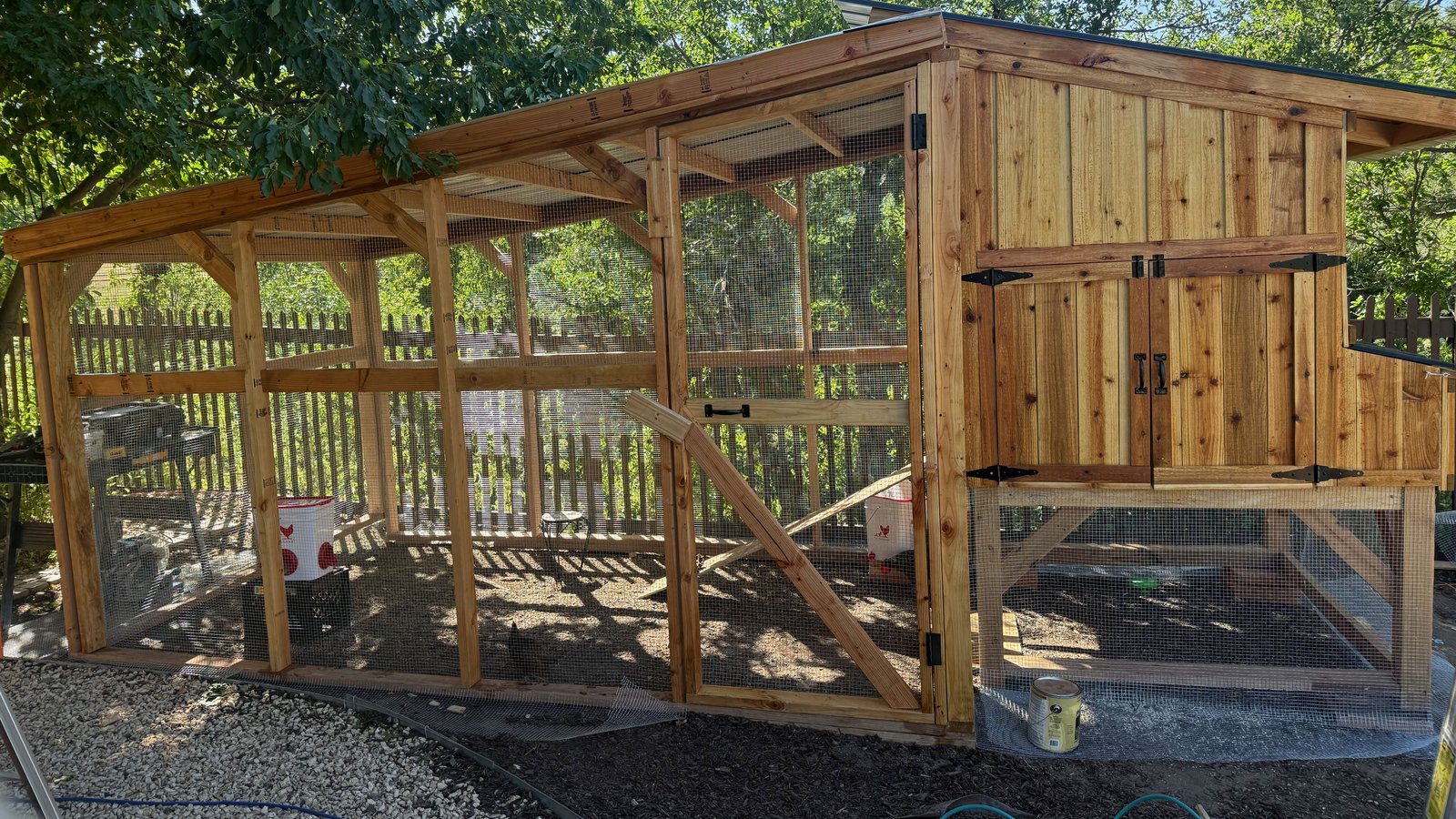
A custom chicken coop in Colorado Springs costs about $1,500 for a small 6-bird build, $3,500–$4,500 for a 12-bird walk-in, and $10,000–$11,000 for a large 20-bird walk-in with a big run. The city lets you keep up to 10 chickens (six months or older, no roosters) with at least 4 square feet of coop per bird, and everything else in this guide is what I’d change about a coop to make it survive 6,035 feet, Front Range wind, heavy snow and real predators. If you’d rather hand the whole build to someone, that’s what my custom chicken coop service is for. If you want to know what you’re getting into first, keep reading.
What Does a Chicken Coop Cost in Colorado Springs?
A chicken coop in Colorado Springs costs $1,500 to $11,000 for my builds, and the price follows three things: flock size, whether you can stand up inside the run, and how much predator-proofing the lot demands.
| Build | Flock | What you get | Typical price |
|---|---|---|---|
| Small | 6 birds | Dutch-style coop, small run | about $1,500 |
| Medium | 12 birds | Walk-in coop and run | $3,500–$4,500 |
| Large | 20 birds | Walk-in with a 342 sq ft run | $10,000–$11,000 |
These are my own ranges for Colorado Springs builds, not national averages (online cost guides tend to run lower because mild-climate coops skip the snow load, wind and wildlife work). Every project gets a written flat-rate estimate with materials, labor and timeline before I start, so you never see an hourly surprise.
One boundary worth knowing: the medium and large sizes are over the city’s 10-bird cap. They make sense on rural lots in unincorporated El Paso County (Black Forest, Falcon, Peyton), not on a typical city lot. For a city flock, the small build or a stretched version of it is the one you actually need.
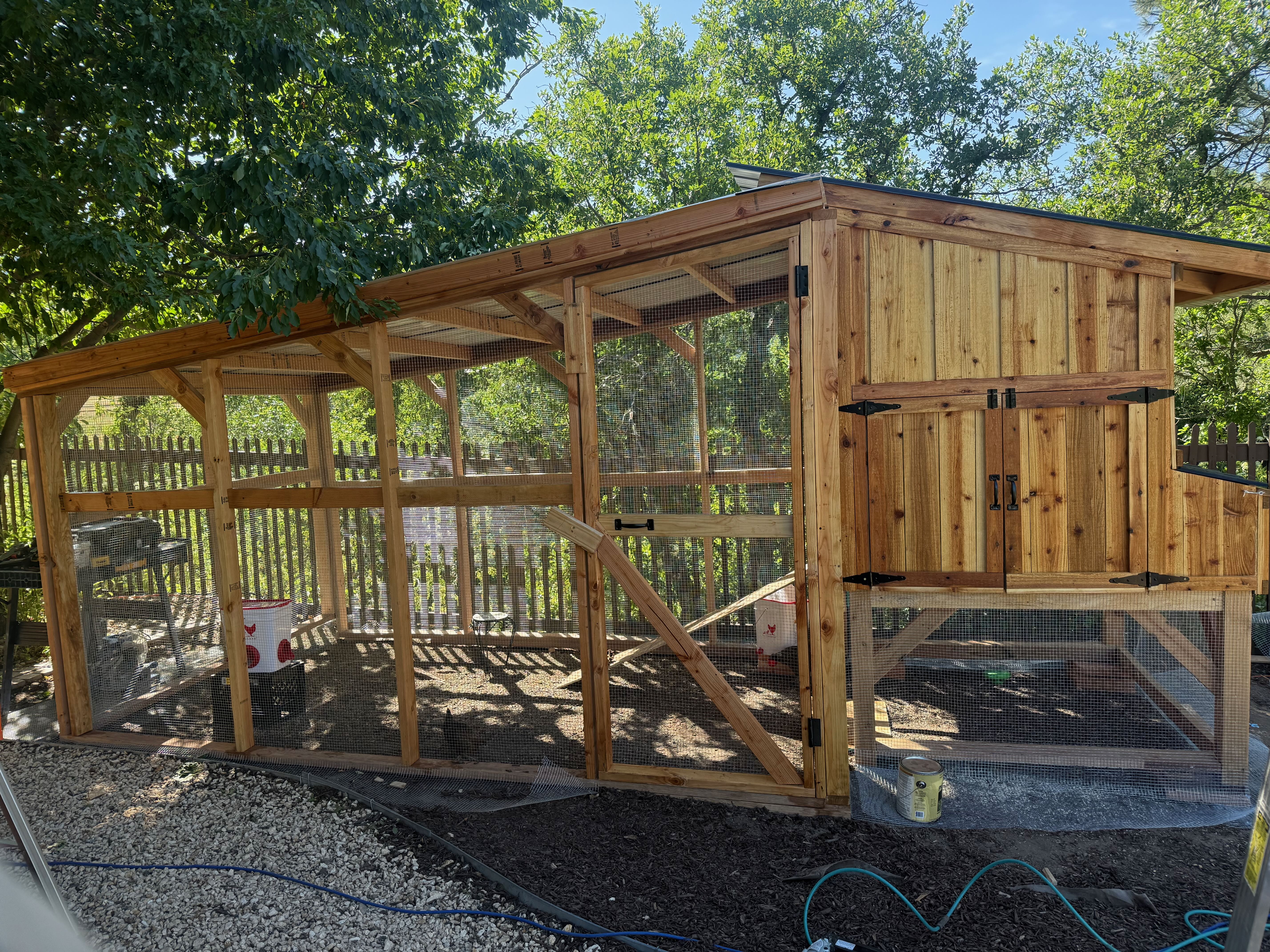
For a sense of a real job, my Broadmoor-area elevated cedar coop with a walk-in run went up in 5 days on site, with hardware cloth on every surface because that lot backs onto open space.
What Does Colorado Springs Allow for Backyard Chickens?
Colorado Springs allows up to 10 chickens (or rabbits) aged six months or older, prohibits roosters, and requires at least 4 square feet of coop space for each bird. That comes straight from the City of Colorado Springs animal regulations page. The same page says coops must meet zoning and building codes, including the accessory structure rules in City Code Subsection 7.3.105.A, and it bans slaughtering animals on residential lots.
Here is what the city page does not give: a setback distance (how far the coop has to sit from your property line) or a permit requirement for chickens. I couldn’t find a setback number there, so I won’t hand you one. If a website (including a coop kit seller) quotes you a specific number of feet, treat it as unconfirmed until zoning confirms it for your lot. Colorado Springs zoning’s phone number is 719-385-5982, and I make that call for clients before I draw anything.
Two other layers can be stricter than the city. Your HOA can limit flock size or coop placement (Briargate, Cordera and Wolf Ranch are common ones where I tell people to ask first), and unincorporated El Paso County follows county rules that tend to be more flexible on lot size.
Do You Need a Permit to Build a Chicken Coop in Colorado Springs?
Usually you don’t need a building permit, but you almost always need a zoning site plan review. The Pikes Peak Regional Building Department (PPRBD) exempts one-story detached accessory structures up to 200 square feet in floor area that sit directly on grade, and says a site/plot plan review is required for all accessory structures, permitted or not. Both points are in the PPRBD detached accessory structures handout.
A 6-hen coop with its run (roughly 24 square feet inside plus 60 outside) falls well under that 200 square foot line. My coops are framed structures that sit on the ground, not on posts dug into it, which keeps them in that “directly on grade” category. The exceptions that catch people: a coop raised on posts or a deck frame isn’t “directly on grade” in the strict reading, so ask the building department rather than assume. A heated waterer or automatic door that needs new wiring can trigger a separate electrical permit. And in El Paso County, buildings proposed for agricultural use are reviewed by county Development Services (the same handout says so).
I treat the permit question as step one, not a surprise at the end. My guide to remodel permits in Colorado Springs walks through how PPRBD and zoning split the work, and the same logic applies to a coop.
How Much Space Does a Chicken Coop Need?
Plan on at least 4 square feet of enclosed coop per bird (the city’s minimum) plus 8 to 10 square feet of run per bird (my own build rule, not city code). Crowded birds peck each other, stress easily and get sick more often. I always tell people to build one size up from what they think they need, because adding birds is easy and rebuilding a bigger coop isn’t.
For a 6-hen city flock, that’s at least 24 square feet inside and about 60 in the run, so something like a 4×6 coop plus a 6×10 run. For the full 10 hens the city allows, plan on 40 square feet inside and 80 to 100 in the run. At that scale, walk-in access to both the coop and the run is worth building in. Cleaning a space you can stand up in takes minutes instead of a crouch-and-reach session.
What Predators Do You Build Against in Colorado Springs?
Build against raccoons, foxes, coyotes, hawks and, on the foothill side of town, bears, and use 1/2-inch welded hardware cloth on every opening instead of chicken wire. Chicken wire holds chickens in; it doesn’t keep predators out. A raccoon pulls through it, a fox chews it and a hawk reaches through the hexagons. Hardware cloth is galvanized steel welded at every intersection, so none of that works.
Four details matter more than people expect:
- A buried or flat apron. Foxes and skunks dig. I run hardware cloth outward from the base of the run (my service work uses a 12-inch apron) so a digger hits wire instead of a way in.
- Hardware cloth over every vent and window. The vents are the weak point on most store-bought coops.
- A locking latch a raccoon can’t work. Raccoons open simple hook-and-eye and slide latches. Use a two-step latch.
- An automatic door. A light-sensor door closes at dusk without you remembering. On wooded or open-space-adjacent lots (the edges of Broadmoor, Black Forest, Falcon) the $150–$200 is cheap insurance.
Bears are the exception to everything above. On the west side of town near the foothills, a standard coop offers essentially no protection, so I use heavier framing and latches a bear can’t manipulate, and I tell people to store feed indoors. Colorado Parks and Wildlife’s guidance on protecting your home from wildlife covers securing poultry and removing attractants like feed.
How Do You Build a Coop for Colorado Springs Snow and Wind?
Design the roof for 30 psf of snow and the framing for strong wind. Those are the numbers PPRBD uses for Colorado Springs in its Pikes Peak Regional Building Code climatic design table: a 30 psf flat-roof snow load (43 psf ground snow load) below 7,000 feet and a 130 mph design wind speed. A coop isn’t a house and isn’t held to every one of those rules, but I use them as the yardstick because they describe what the site actually does.
Snow. A single-slope metal roof sheds snow and needs almost no upkeep, so it’s my default. Flat or low-slope roofs that collect snow are where I’ve seen sagging rafters. I cover the same load logic in my pergola snow load and permit guide.
Wind. Front Range wind gets under overhangs and lifts light roofing. I use real hurricane ties (metal connectors) on rafters instead of toenailed nails.
Frost. I don’t dig posts for a coop. It’s a framed structure that sits on the ground, so there are no footings for frost to heave, and the 30-inch frost line that governs deck and fence posts (see my frost line guide and fence repair guide) doesn’t come into it.
How Much Ventilation Does a Chicken Coop Need?
Give the coop about 1 square foot of vent opening for every 10 square feet of floor, high on the walls near the roofline. That’s my build rule of thumb, and it works because droppings give off moisture and ammonia, and ammonia hurts a chicken’s lungs before you can smell it.
The common mistake is sealing the coop tight for winter. Chickens handle cold far better than they handle ammonia and damp. A well-vented coop with clean, dry bedding carries a healthy flock through a Colorado Springs winter without extra heat in most cases. What you want to avoid is a draft at roost level (cold air blowing directly on sleeping birds), and high vents move air without that.
Summer is the other half. Colorado Springs sees daily temperature swings of 40°F or more, and an afternoon in a poorly vented coop can get dangerously hot even at 6,035 feet. Openings on more than one side let air flow through, and they’re easier to build in than to add later.
What Goes Inside the Coop: Nesting Boxes, Roosts and a Droppings Board?
Plan on one nesting box per 3 to 4 hens, 12 inches of roost bar per bird, and a removable droppings board under the roost.
Nesting boxes should be about 12×12×12 inches, mounted lower than the roost bars, with an exterior door so you can collect eggs without going in. Hens sleep in the highest spot they can find, so a box above the roost becomes a bed (and a toilet). Six hens need two boxes. They’ll still all queue for the same one (I’ve built boxes for every bird and watched them line up anyway).
Roost bars go 2 to 3 feet off the floor. A 2×4 laid flat with rounded edges is a common choice because a wide, flat perch lets birds cover their feet with their bodies in winter.
A droppings board directly under the roost catches most of the night’s mess. Pull it out, scrape it, put it back. Two minutes, and the coop stays dramatically cleaner.
What Materials Hold Up Best for a Chicken Coop in Colorado Springs?
Use plain Douglas fir or pine for framing and interior surfaces, cedar or LP SmartSide for siding, and a metal roof. Colorado’s UV, snow and temperature swings are hard on bare wood and cheap shingles.
Interior: I keep cedar out of the living space of the coop. Its aromatic oils are what make it rot-resistant outdoors, and in a closed-up coop with low airflow I’d rather not have chickens breathing them (I’ve talked more than one client out of using leftover cedar fence boards inside). Use non-aromatic lumber for framing and anything inside the living area.
Siding: Cedar on the outside is fine over a layer of OSB (oriented strand board, a common wood panel), which separates the birds from the wood. LP SmartSide, a factory-made wood siding, barely warps, holds paint well and skips the cedar question entirely.
Roof: Metal lasts longer than asphalt shingles, sheds snow cleanly and handles high-altitude sun. If you use shingles, put a radiant barrier sheathing under them to cut summer heat.
Finish: Every outside surface needs a UV-resistant paint or stain. At 6,035 feet the sun is stronger, so cheap paint and bare wood wear faster than the label suggests. A quality exterior paint on SmartSide should last 5 to 7 years before a refresh. Same lesson as my deck staining guide if you’re curious.
Can The Colorado Handyman Build Your Chicken Coop?
Yes, I build custom coops to everything above, and my chicken coop service page lists what’s included. Call (719) 243-9718 for a free written flat-rate estimate. Getting a coop right once is cheaper than rebuilding it, and a flock that survives its first winter is the best advertisement for it. If you’re also thinking about winter growing, my Walpini greenhouse guide covers the other backyard project I build for Colorado conditions.
Questions people ask
How many chickens can I have in Colorado Springs?
The City of Colorado Springs allows up to 10 rabbits or chickens aged six months or older, and roosters are prohibited. Each coop needs at least 4 square feet per bird. Your HOA can be stricter than the city, and unincorporated El Paso County (Black Forest, Falcon, Peyton) follows county rules, so confirm both before you build.
Do I need a permit to build a chicken coop in Colorado Springs?
Usually not a building permit. The Pikes Peak Regional Building Department exempts one-story detached accessory structures of 200 square feet or less that sit directly on grade. A site (plot) plan review with zoning is still required for accessory structures, permitted or not, and a heated waterer or other new electrical work can need its own electrical permit. Call Colorado Springs zoning at 719-385-5982 before you build, and check HOA rules.
Should I insulate or heat a chicken coop in Colorado Springs?
Most healthy adult flocks do not need heat or insulation here. Dry bedding, no draft at roost level and high vents matter more than warmth, because trapped moisture and ammonia hurt chickens more than cold does. Skip heat lamps (a fire risk in a wood coop). A heated waterer on a properly wired circuit is the winter upgrade that earns its keep.
Is it better to build a coop or buy a kit?
A kit is fine for a small flock in a fenced yard with little predator pressure. It is a poor fit near the foothills or open space, because most kits ship with light framing and chicken wire that raccoons can pull through. A custom build costs more up front, but you size it to your flock, your snow load and your wildlife, and it lasts years longer.
How long does it take to build a chicken coop?
My Broadmoor-area build, an elevated cedar coop with a walk-in run, took 5 days on site. Small coops go faster and large walk-in builds take longer. Add time up front for the written estimate, materials and any zoning plot plan review.
Ready to Get Started?
Flat-rate written estimate, no hourly surprises. Serving Colorado Springs, Monument, Fountain, Woodland Park, and the Pikes Peak region.