
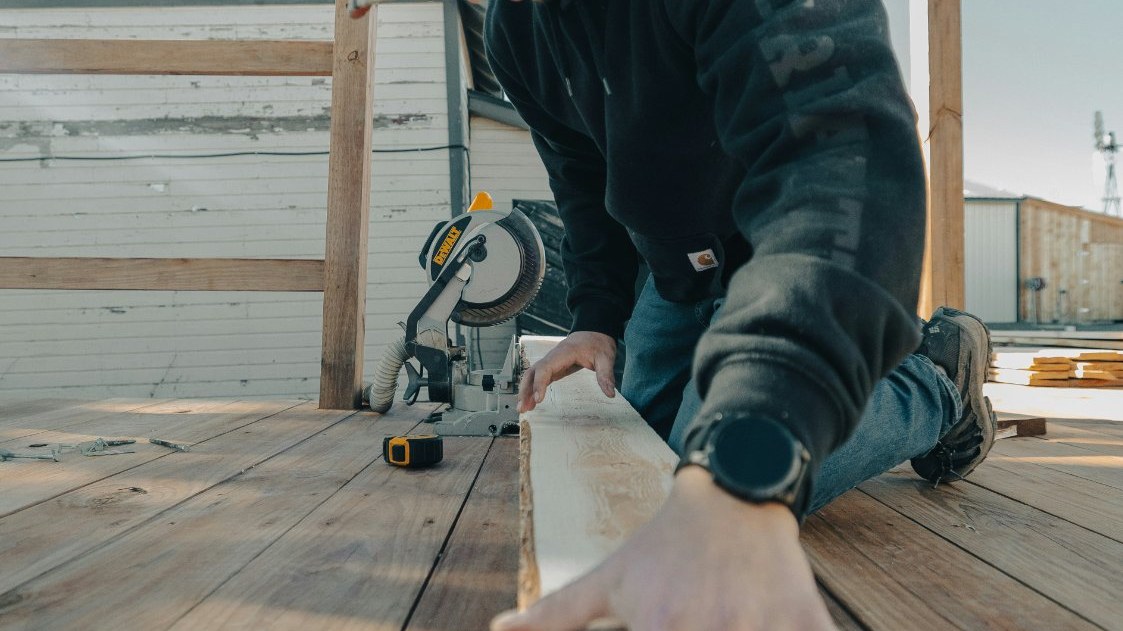
Stain your deck every 2–3 years in Colorado Springs, not the 4–5 years the can recommends (that number’s calibrated for sea level, not our altitude). Follow the can’s schedule up here and your deck will be gray, cracked, and soaking up water by year three, something I see on decks all over town. At 6,035 feet, UV rays run about 25% stronger than at sea level, breaking down stain 30–40% faster than the can’s timeline assumes.
What Does UV at Altitude Actually Do?
Stain soaks into the wood grain and leaves behind a layer that blocks UV rays. That layer slows down how fast the wood takes on water and wears at the surface. Up at altitude, the stronger sun burns through that layer faster. On decks that face south or west (the ones that get direct afternoon sun), we see heavy graying and surface cracking by year two.
The first sign you can see isn’t peeling. It’s the wood starting to gray and dry out (that graying is the first thing I look for when I walk up to a deck for an estimate). By the time you see surface checking (small cracks that run along the grain), the UV protection is already gone and water is working into the wood.
What Is the Right Timing Window for Deck Staining?
Deck staining in Colorado Springs has a best window: late spring (after the last frost, around May 8) through early fall (before about October 5). The two things that matter most are the surface temperature of the wood and the weather forecast.
The wood surface needs to stay between 50°F and 90°F while you apply the stain and for 48 hours after. Colorado afternoons can push deck surfaces above 90°F in July. Stain put on a too-hot surface dries too fast and doesn’t soak in. The best time is early morning, on a day that won’t climb past 85°F.
You also need a rain-free forecast for at least 48 hours. Even a quick shower on fresh stain can leave lap marks (streaks where wet and dry areas overlap) and uneven soak-in.
What Should You Use at Altitude?
Film-forming finishes, like solid stains and paints, are the wrong choice for Colorado decks. They sit on top of the wood instead of soaking in. When they wear out, they peel, and peeling is far more work to fix than a stain that has simply faded.
The right product is a penetrating stain (one that soaks into the wood) in a semi-transparent or semi-solid finish, with UV inhibitors. UV inhibitors are ingredients that slow sun damage. Brands that hold up well at altitude include Armstrong Clark, Defy Extreme, and TWP (Total Wood Preservative). Skip the big-box store house brands (I’ve tried enough of them over the years to know which ones fade fast up here). The quality of their UV inhibitors varies a lot.
Why Does Nobody Skip the Prep Work?
Stain put on dirty or weathered wood grips poorly and fails early. Here is the prep order: wash the deck well with a deck-wash product or an oxygen bleach mix, rinse it, let it dry all the way (usually at least 48 hours in Colorado’s dry air), then stain.
If the old stain has really broken down, use a deck brightener after cleaning. Deck cleaners are alkaline (high pH), and a brightener is a mild acid that balances the wood back out. It also opens up the grain so the new stain soaks in better.
We include full prep in every deck staining estimate: surface washing, brightening if needed, and two coats of penetrating stain. The difference between a stain job that lasts three years and one that lasts two is almost always the prep, and it’s the one shortcut I won’t let a crew take.
Questions people ask
How often should I stain my deck in Colorado Springs?
Every 2–3 years, significantly more often than the 4–5 year cycle recommended at lower elevations. At 6,035 feet, UV radiation is 25%+ more intense than at sea level, breaking down stain 30–40% faster than manufacturer timelines suggest.
Ready to Get Started?
Flat-rate written estimate, no hourly surprises. Serving Colorado Springs, Monument, Fountain, Woodland Park, and the Pikes Peak region.