
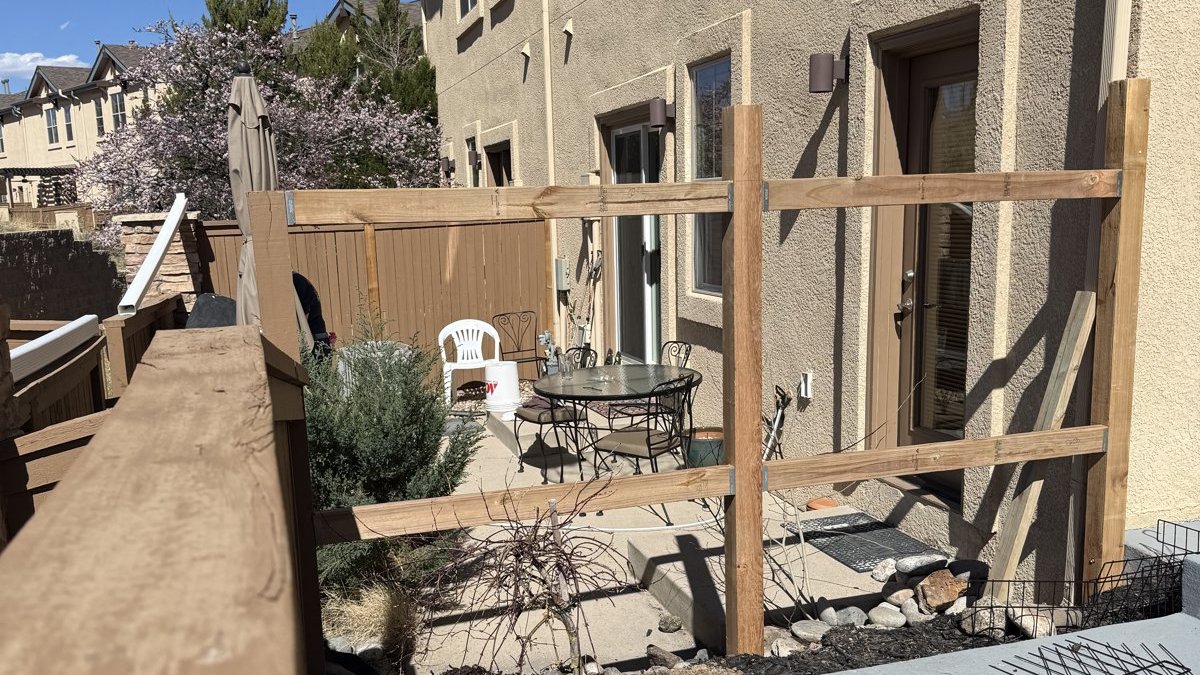
Fence repair in Colorado Springs usually means fixing the posts, not the boards: resetting one post runs $175–$275, replacing a rotted post $250–$600, and repairing a section of boards and rails $300–$800. Nine times out of ten when I get called out for a leaning or wobbly fence, the footing (the concrete that holds the post in the ground) was set above the 30-inch El Paso County frost line, or it was set right and 100+ freeze-thaw cycles a year have worked it loose. A sagging gate is usually the same story, and the fix is a flat estimate, not a guess.
What Does Fence Repair Cost in Colorado Springs?
Most fence repairs here land between $175 and $800, and a whole new wood fence runs about $17–$50 per linear foot. Here is how I price the common jobs, and what each one includes:
| Job | Typical cost | What it covers |
|---|---|---|
| Reset one sound post | $175–$275 | Dig out the old footing, reset the post at least 30 inches deep on gravel, re-hang the rails |
| Replace one rotted post | $250–$600 | New ground-contact post, new footing, rails and boards re-hung |
| Repair a section | $300–$800 | Several posts, rails and boards in one run |
| Fix a sagging gate | $275 minimum visit if hardware or a brace fixes it; add a post reset ($175–$275) if the gate post moved | New hinges, a diagonal brace or a latch adjustment |
| New wood privacy fence | $17–$50 per linear foot | Full replacement; the range runs from basic wood to 6-ft cedar privacy |
The post figures are my own flat-rate numbers (they match our handyman pricing guide). The replacement and new-fence ranges come from local Colorado Springs fence contractor price sheets (for example Big Blu’s published 2026 pricing). Rocky Front Range soil, a post tight against a property line, and a footing that won’t come out in one piece all push a job toward the top of its range.
How Do I Know if It Is the Post or the Fence?
Do the push test: put both hands on the post and push firmly in each direction, and any movement at all means the footing has failed. It’s the first thing I do on every fence call, and it takes ten seconds. A sound post won’t budge. A failed footing will rock, sometimes a quarter inch, sometimes a lot.
What you’re feeling is the block of concrete pulling away from the soil. Once that gap opens, water gets in, freezes and widens it, and every winter after makes it worse. Bracing the post from the outside buys one season at best (I’ve watched it shift the load onto the next post, which then fails too). If the post is firm and only the boards are split or loose, you have a board repair, which is the cheaper job.
Why Do Colorado Footings Fail Faster?
Colorado footings fail faster because the ground here freezes 30 inches deep, and any post set shallower sits in the zone that heaves every winter. That 30-inch figure is the El Paso County frost line PPRBD holds posts and footings to, and our frost line guide breaks it down by area (Woodland Park and Teller County are 48 inches). Posts set 18 or 24 inches deep, common in DIY builds and budget installs, get pushed up a little each winter. Freeze-thaw is a fair culprit here because a fence is exterior; the same logic does not apply to anything inside a heated house.
Frost heave is only one of four things I see beat up Colorado Springs fences:
- Wind. Downslope wind events along the Front Range hit a 6-ft privacy fence like a sail. The panel holds, the footing rocks, and the post eventually lets go or snaps at the soil line.
- UV. At 6,035 feet, UV is roughly 25% more intense than at sea level, so untreated pine boards check and gray fast.
- Dry air. Boards swing from bone-dry to damp, then split at the nail lines.
- Hail. Cracked boards and missing post caps after a storm let water into end grain (our hail season checklist covers the fence walk).
How Deep and How Should a Fence Post Be Set?
Set a six-foot fence post at least 30 inches deep in El Paso County so the base sits below the frost line. Two details matter as much as depth, and most budget repairs skip both: a few inches of gravel at the bottom of the hole so water can drain away, and a concrete pour mounded slightly above the ground so water runs off instead of pooling at the post. A post set this way will outlast every board, rail and hinge around it (I’ve pulled 20-year-old posts set correctly that were still rock-solid, right next to five-year-old posts set wrong that were already rocking loose).
Corner and gate posts carry more sideways load, so I set those deepest and sometimes wider. In Woodland Park and Teller County the depth goes to 48 inches. The exact number for your address comes from PPRBD, so confirm it at pprbd.org or call (719) 327-2880.
Which Wood Holds Up Best at Altitude?
Use ground-contact pressure-treated posts rated UC4A or better, cedar for rails and boards, and a penetrating stain. Pressure-treated lumber comes in treatment levels stamped on the end tag. UC3 is rated for above-ground use, not for sitting in soil, and UC4A is rated for ground contact, which is what a buried post needs. Standard lumber yard posts are often UC3 or unmarked, so check the tag before you buy.
Above ground I lean toward cedar because it handles UV and humidity swings better than pine. That same UV intensity is why decks here need restaining every 2–3 years instead of every 5 (see deck staining). The combination that holds up: UC4A posts below the frost line on gravel, cedar above ground, finished with a UV-resistant penetrating stain (one that soaks in instead of coating the surface). One exception: if the bottom of a post is soft enough to push a screwdriver in, the same rot problem I describe in deck joist rot is already under way, and that post is a replacement, not a reset.
Do I Need a Permit for a Fence in Colorado Springs?
No building permit is needed for a fence 7 feet tall or less, but zoning and HOA rules still apply. PPRBD’s list of work that does not require a permit includes fences not more than 7 feet in height, so a standard 6-ft privacy fence and most repairs need no permit. The City of Colorado Springs’ fencing standards treat anything over 7 feet as an accessory structure needing a PPRBD permit and limit fences in front of the house to 4 feet. Some city and third-party guidance cites 6 feet as the cutoff, so for anything near that height, check with PPRBD at (719) 327-2880 before you build. HOAs in neighborhoods like Briargate and Flying Horse often require approval of height, material and color on top of that.
When Does Repair Make More Sense Than Replacement?
Repair when the damage is isolated, and replace when the footings are failing across the fence. Replace the full fence when more than 40% of posts have failed footings, when the fence is over 15 years old and boards are consistently splitting, or when the style no longer matches the property (that 40% line is my rule of thumb from jobs, not a code number). Repair makes sense for isolated post failures in an otherwise sound fence, boards damaged by one hail event or a vehicle, or a sagging gate that needs new hardware and a post reset. After a wind storm, undamaged panels can often be re-hung on new posts.
If you’re sharing the fence with a neighbor, the repair-or-replace question is also a who-pays question. See the FAQ below; Colorado’s cost-sharing statute covers farm and grazing land, not ordinary city lots.
We do a free walkthrough and written flat-rate estimate on every fence project, repair or replacement, through our fence and exterior repair service in Colorado Springs.
Questions people ask
How much does it cost to replace one rotted fence post in Colorado Springs?
Replacing a rotted post runs about $250–$600 per post, and resetting a sound post that has only come loose runs $175–$275. Replacement costs more because the old post and its concrete have to come out, a new pressure-treated post is set at least 30 inches deep, and the rails and boards are re-hung. Rocky soil, a post tight against a neighbor's property line, or a stuck concrete footing push a job toward the high end. A written flat-rate estimate before work starts fixes the number.
Why do fence posts heave in Colorado Springs?
Fence posts heave when water in the soil freezes and expands around a post that sits above the 30-inch El Paso County frost line, lifting it a little each winter. Wide daily temperature swings and 100+ freeze-thaw cycles a year repeat that movement, and a post with a flat concrete top lets water pool against it. Setting the post below 30 inches, over a gravel base, with the concrete crowned to shed water, is what stops it.
Who pays to repair a shared fence between two houses in Colorado?
For ordinary residential lots, Colorado's partition fence statute does not require neighbors to split the cost. That law (C.R.S. 35-46-112 and 35-46-113) covers adjoining agricultural and grazing land, so most city neighbors work it out by agreement. I suggest getting a written estimate, sharing it with your neighbor before work starts, and putting any agreement in writing. Check your HOA covenants too, because some assign fence maintenance. This is general information, not legal advice.
Do I need a permit to build or replace a 6-foot fence in Colorado Springs?
Not a building permit. PPRBD lists fences not more than 7 feet tall as work that does not require a permit, so a 6-foot privacy fence does not need one. Zoning still applies: the City of Colorado Springs limits fences in front of the house to 4 feet, and HOAs often require approval of height, material and color. Rules differ for county and Woodland Park addresses, so confirm with PPRBD at (719) 327-2880 before you build.
Can I reuse fence panels after a wind storm blows them down?
Often yes, if the panels are not split and the rails are still solid. Most wind failures are the posts, not the panels: the footing rocks loose or the post snaps at the soil line, and the panel comes down with it. I re-hang undamaged panels on new posts set below the frost line. Panels with split rails, cracked pickets or rot at the bottom edge are cheaper to replace than to repair.
Ready to Get Started?
Flat-rate written estimate, no hourly surprises. Serving Colorado Springs, Monument, Fountain, Woodland Park, and the Pikes Peak region.