
A cheap kitchen faucet in Colorado Springs hard well water lasts 2 to 4 years before it drips or gets stiff to turn; a quality one with a ceramic disc cartridge and brass body runs 10 to 20 years, whether you’re on well water or the city’s softer supply. City water from Colorado Springs Utilities is soft to moderately hard (1.3 to 2.8 grains per gallon), so it sees less mineral buildup, but a private well in Black Forest, Falcon, and Monument carries a lot more calcium and magnesium that settles fast inside valves, aerator screens, and cartridge seats. What actually determines how long a faucet lasts isn’t brand name or price, it’s specific design choices you can check before you buy.
What Does Hard Water Actually Do to a Faucet?
Calcium and magnesium carbonate separate out of hot water and settle on the surfaces the water touches. In a faucet, this happens in three places:
The cartridge or valve: The cartridge is the part inside the faucet body that controls water flow and temperature. It’s where hot and cold water mix and where flow starts and stops. Every drop of water that moves through it leaves a bit of mineral scale (a hard, chalky crust). Over time, that scale builds up on the sealing surfaces and moving parts.
The aerator: The aerator is the small screen at the tip of the spout. Its job is to mix air into the water to cut down on splash and slow the flow. The screen openings are small (about 0.5 to 2 mm), so mineral deposits clog them quickly. A clogged aerator cuts the flow and makes the stream uneven and spraying. This is the most common hard water problem and the least serious, and it’s easy to fix.
The outside surfaces: As water droplets dry, they leave white chalky spots on the faucet body, handle, and base. This is a looks problem, not a mechanical one. But it’s what makes chrome faucets look grimy in Colorado Springs kitchens no matter how often you wipe them down.
The Cartridge Decision: The Most Important Spec
The cartridge type determines how long a faucet functions mechanically in hard water. There are three main types:
Ceramic disc cartridges use two polished ceramic discs that turn against each other to control flow. Ceramic is very hard, harder than the mineral scale itself, so deposits can’t easily scratch it or stick to the sealing surfaces. The discs keep their seal even when some mineral builds up on the housing around them. Ceramic disc faucets usually have a single lever that moves left and right for temperature and up and down for flow.
In hard well water, ceramic disc cartridges routinely last 10–20 years without requiring replacement, and they hold up just as well on Colorado Springs’ softer city water. This is the cartridge type to specify.
Ball valve cartridges use a rotating ball with holes (ports) that line up with the water inlets to control flow and temperature. The ball rests against rubber O-rings and springs. Mineral scale builds up in the ports and on the O-rings, and once it does the ball can’t close all the way, so the faucet drips. Ball valve faucets are common in cheaper single-handle kitchen faucets. In hard water, expect 3 to 6 years before dripping or stiffness sets in.
Rubber seat and spring cartridges are used in two-handle faucets (separate hot and cold controls). A rubber washer presses against a seat to stop the flow when you turn the handle off. Mineral scale on the rubber seat causes dripping. This is the most common reason a two-handle faucet starts to drip in hard water. You can fix it by replacing the cartridge or the seat washer, but on a hard well these need attention every few years.
For a kitchen faucet you expect to last a decade or more: specify ceramic disc. The box or spec sheet will say it. If it doesn’t specify, ask or look up the model number.
Finish Selection: What Stays Clean in Hard Water?
The finish you choose sets how much upkeep the outside of the faucet needs, especially if your home is on well water with hard mineral content.
Spot-resistant brushed nickel: The most practical choice in this market. The brushed texture and a spot-resistant PVD coating make water spots hard to see. (PVD, or physical vapor deposition, is a tough coating bonded to the metal in a vacuum chamber.) The same finish that resists fingerprints also resists the mineral spots left by drying water. It looks clean between cleanings in a way polished chrome doesn’t.
Matte black: Popular and very practical in hard water. The dark, flat surface hides water spots well. The PVD coating on quality matte black faucets is tough and stands up to the chlorine in city water. One catch: cheaper matte black finishes scratch and show wear more easily than brushed nickel. Confirm the faucet has a PVD coating before you buy.
Polished chrome: The traditional choice and the hardest to keep clean in hard water. Every water droplet that dries leaves a white spot on the mirror-bright surface. If you want polished chrome, budget for a water softener or plan on wiping the faucet down daily.
Oil-rubbed bronze: This is a living finish, meaning it changes color and darkens over time to form a patina (an aged surface layer). In hard water, that patina picks up mineral deposits. Depending on the faucet and your taste, it can look intentional or it can look neglected. It is not a maintenance-free choice in Colorado Springs.
Brushed gold / champagne bronze: Growing in popularity. Quality PVD-coated brushed gold holds up well. Cheaper plated finishes wear through. Stick to brands that list a PVD coating.
Body Material: Brass vs. Zinc vs. Plastic
Faucet bodies are made from brass, zinc alloy (sometimes called zamak), or plastic. This is where budget faucets cut cost in ways that matter.
Solid brass body: The most durable option. Brass resists corrosion from the water inside and the cleaning products outside. It’s heavy. If a faucet feels solid and substantial in your hand, it’s likely brass or has a lot of brass in it. Most quality faucets from Delta, Moen, Kohler, and similar brands use brass bodies in their main product lines.
Zinc alloy body: Common in mid-range and value faucets. Zinc alloy corrodes more easily over time, especially at the threaded supply connections (where the faucet screws onto the water lines). On hard well water, a zinc alloy body typically lasts 5 to 8 years before corrosion shows up at those connections. On Colorado Springs’ soft-to-moderate city water, it lasts longer, but is still less durable than brass.
Plastic body: Budget faucets under $80 often have plastic body parts. In normal home use, plastic holds up fine mechanically. But in Colorado Springs, hard water and the extra cleaning it takes wear plastic down faster than metal, and the plastic threads are easier to strip or crack during installation or a cartridge swap.
For a forever faucet: brass body, ceramic disc cartridge, PVD-coated finish.
The Aerator: How Does Simple Maintenance Extend Faucet Life?
The aerator is the easiest part to maintain on a kitchen faucet, and the one most people ignore until the flow drops off.
Unscrew the aerator from the tip of the spout (turn counterclockwise, by hand or with pliers and a cloth to protect the finish). Inside you’ll find a small screen. In hard water it will be coated with white mineral deposits. Soak it in white vinegar for 30 minutes, scrub it with an old toothbrush, rinse, and screw it back on. The flow should come right back.
Do this every 6 to 12 months in Colorado Springs. It’s a 15-minute job that keeps the faucet running like new between cartridge changes. If the aerator is damaged or too corroded to clean, replacements cost $3 to $8 at any hardware store and usually swap right in within a brand.
Pull-Down vs. Pull-Out Spray Heads
Pull-down and pull-out faucets have a spray head that pulls out on a hose and retracts back into the spout. They’re the most popular kitchen faucet style right now, and they add one more hard water weak point: the spray head connection and the diverter valve inside.
The diverter valve is what switches the water between the main spout and the spray head. Mineral scale can make it stick in one position, so the spray head won’t switch modes right. In hard water, diverter problems show up faster than in soft-water areas.
For pull-down faucets in Colorado Springs: look for magnetic docking (the spray head is held in place by a magnet instead of a spring) and a cartridge you can replace yourself. Both make upkeep easier down the road. Moen’s Spot Resist finish paired with their ceramic cartridge is a strong combination for this market, and Moen is widely available locally, which matters for warranty service.
Which Faucet Brands Are Worth Specifying in Colorado Springs?
This isn’t a complete list, and brands add and drop models all the time. What follows are the traits to look for, with examples of brands that consistently hit them:
Delta: Lifetime warranty, ceramic disc cartridges across most lines, and WaterSense-certified models (an EPA label for fixtures that use less water). Delta’s newer faucets use Diamond Seal technology, a diamond-coated ceramic disc the company rates for up to 5 million uses. Good local availability.
Moen: Lifetime warranty on finish and function, ceramic cartridges, and Spot Resist finish across multiple lines. Strong track record in hard water markets. Replacement cartridges are widely available.
Kohler: Premium brand, excellent ceramic valves, strong finish quality. Usually priced higher than Delta and Moen for a similar spec.
Brizo: Delta’s premium line. The cartridge engineering is the same as Delta’s, with higher-end design and finish.
Brands to be careful with for a forever install: most store house brands (the big-box chain’s own label) and most faucets under $100 in single-handle pull-down styles. The $79 pull-down faucet at the home improvement store has a plastic cartridge and a zinc body. It will work for a few years. It won’t be there at year ten.
A Real-World Test of the Framework: The IKEA GAMLESJÖN
While writing this article I kept thinking about a faucet I saw at IKEA. Matte black, square gooseneck spout, industrial wheel handles: exactly what I’d put in the old brick and steel-beam warehouse I’m going to restore someday (when I find one). My first instinct was that it was a style-first product. It looks striking, probably has a plastic cartridge, and won’t last three years in Colorado Springs water.
I went and looked up the specs before dismissing it.
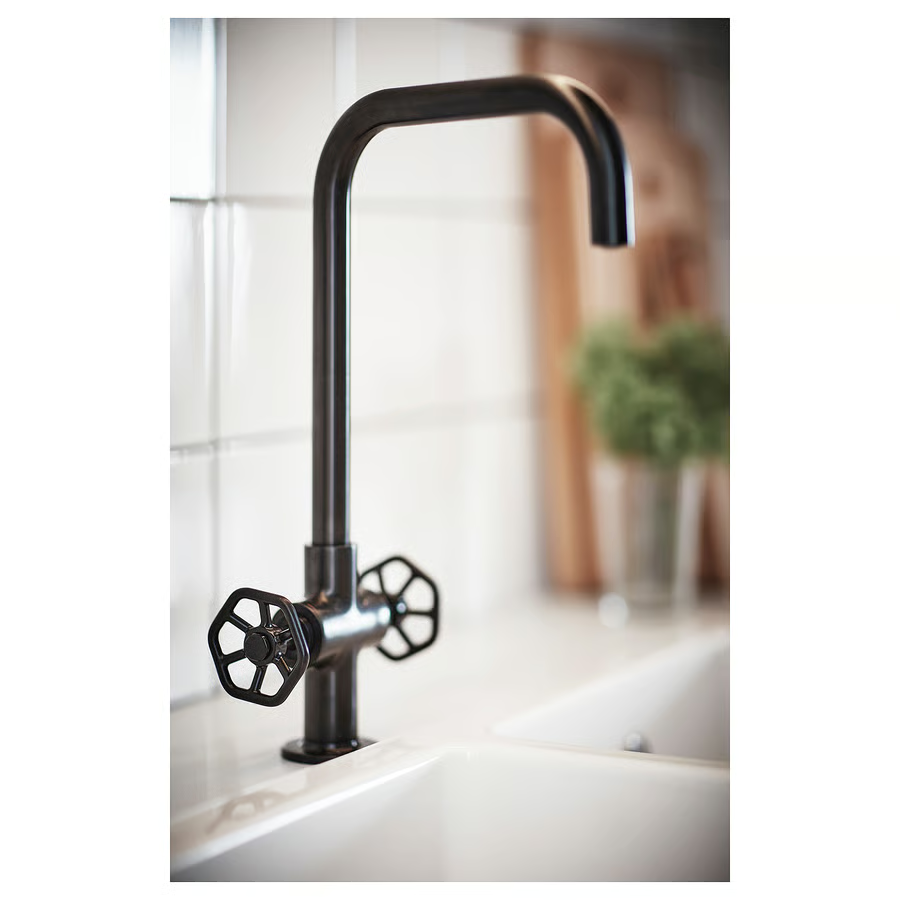
IKEA GAMLESJÖN kitchen faucet. Photo courtesy of IKEA.
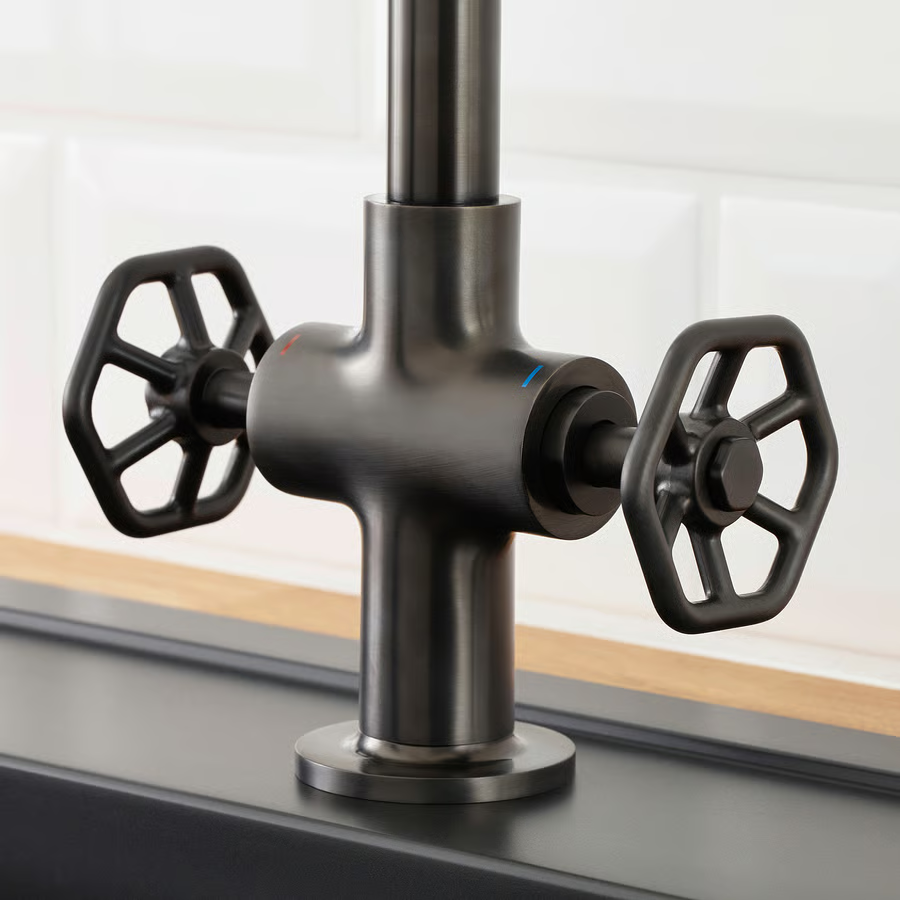
The dual wheel handle configuration. Photo courtesy of IKEA.
IKEA’s product description for the GAMLESJÖN states: “The faucet insert has hard, durable ceramic discs that can handle the high friction that occurs when you change the temperature of the water.” (See the full specs at IKEA.com →)
The most important thing? I think it looks really cool. The second most important thing? It’s actually a quality faucet, with a ceramic disc cartridge, the standard you should hold for every faucet regardless of price or brand.
The full picture on the GAMLESJÖN for a Colorado Springs kitchen: the ceramic disc cartridge is the right call and checks the most important box. The matte black finish is practical for hiding hard water spots. The two-handle wheel design means separate hot and cold controls. In hard water that means two cartridges instead of one, so twice the maintenance exposure. But ceramic discs last long enough that this is a minor point.
What’s still unknown: the body material (IKEA doesn’t clearly list brass vs. zinc alloy on this model), the warranty terms, and whether parts are available locally if a cartridge ever needs replacing. Those are worth confirming before you buy. A ceramic cartridge that’s hard to find locally becomes a service headache when it finally needs attention.
The lesson I took from looking it up: don’t assume a striking design means a cheap product, and don’t assume a high price means quality engineering. The cartridge spec is what matters. A faucet at any price, IKEA, Delta, Kohler, or a boutique brand, is worth judging on the same checklist: ceramic disc, brass body, spot-resistant finish, and parts you can get.
The IKEA GAMLESJÖN earns more credit than I first gave it. Whether it’s the right choice for your Colorado Springs kitchen depends on those warranty and parts questions. But it’s not the style-over-substance product I assumed it was.
Images: IKEA GAMLESJÖN kitchen faucet. Photos courtesy of IKEA.
What Does a Kitchen Faucet Cost in Colorado Springs?
A quality kitchen faucet with ceramic disc cartridge, brass body, and spot-resistant finish runs $250–$600 at retail. Installation by a plumber runs $100–$200 for a standard swap. Total installed: $350–$800.
A budget faucet costs $60 to $150 for the faucet itself. But it lasts only 2 to 4 years in Colorado Springs water, so over a decade you replace it two or three times. Add a plumber for each swap ($100 to $200) and you land at roughly $600 to $750 all in. That’s about the same as buying the quality faucet once, and you skip the repeat disruptions and installs.
The math for a well-water home in the Colorado Springs area is simple: hard water widens the gap between cheap and quality faucets. That gap is bigger for a hard well than for a home on the city’s softer water. Buy the ceramic disc, brass body faucet once.
For faucet installation or kitchen plumbing work in Colorado Springs, call (719) 243-9718.
Questions people ask
What type of faucet cartridge holds up best in Colorado Springs hard water?
Ceramic disc cartridges are the most durable option in hard water. The disc mechanism uses two ceramic discs that rotate against each other to control flow. Ceramic is highly resistant to mineral buildup. Ball valves and rubber seat cartridges are significantly more vulnerable to hard water damage. Mineral scale deposits on rubber seat surfaces and inside ball valve ports, causing dripping and stiff operation within a few years if you're on a private well with hard water. Colorado Springs city water is soft to moderately hard, so the effect is slower there.
What faucet finish hides hard water spots best?
Spot-resistant brushed nickel and matte black are the most practical finishes in Colorado Springs. Both are designed to resist fingerprints and water spots. The same surface treatment that resists fingerprints also resists mineral deposits from hard water. Polished chrome shows every water spot and requires constant maintenance to look clean. Oil-rubbed bronze develops a patina that can work with hard water aesthetically but is not a spot-resistant coating.
How do I know if my faucet is failing from hard water damage?
The most common hard water failure signs: dripping from the spout when off (mineral deposits on the rubber seat prevent full closure), stiff or grinding handle operation (scale buildup inside the cartridge), reduced flow or uneven stream (aerator clogged with mineral deposits, which is easy to fix by unscrewing and soaking the aerator in vinegar), and white chalky buildup at the base of the spout or around the handle. Aerator cleaning is maintenance; cartridge replacement is repair; full faucet replacement is when repair isn't cost-effective.
Is it worth buying an expensive faucet in Colorado Springs?
Yes, especially if your home is on a private well with hard water. A $60 faucet with a plastic cartridge in hard well water lasts 2–4 years before dripping or becoming difficult to operate. A $300–$500 faucet with a ceramic disc cartridge and solid brass body lasts 10–20 years with basic maintenance, whether you're on well water or Colorado Springs' soft-to-moderate city water. The cost difference over a decade, including two or three replacements of the cheap faucet plus installation each time, strongly favors buying quality once.
Ready to Get Started?
Flat-rate written estimate, no hourly surprises. Serving Colorado Springs, Monument, Fountain, Woodland Park, and the Pikes Peak region.