
True black mold (Stachybotrys chartarum) is rare in Colorado Springs homes, because our dry climate almost never gives it the conditions it needs. After 15 years of remodeling Colorado Springs homes, opening walls and pulling tile, what I actually find growing in damp spots is common, manageable mold: Aureobasidium on grout and caulk, Cladosporium on windowsills, Aspergillus around heating and cooling parts, nothing like Stachybotrys, the real “toxic black mold” that fills home improvement forums and late-night news (I’ve had homeowners convinced they had it more times than I can count, and it almost never is). Before you reach for the phone or the bleach, here’s what actually grows in Colorado Springs homes, what deserves real alarm, and what’s just a cleaning problem.
The Colorado Context: Why Is True Black Mold Rare Here?
Stachybotrys chartarum, the “toxic black mold” that shows up in every scary headline, needs steady humidity above 90% and a constant source of water to get going. It grows slowly and doesn’t compete well against other molds under normal conditions.
Colorado Springs indoor humidity runs 10–20% in winter. That’s one of the worst places in the country for Stachybotrys to grow. It can still show up, but only after long-running, active water intrusion: a roof leak ignored for months, a basement with standing water, or a plumbing failure that soaked a wall for weeks (I’ve walked into a few finished basements where that was exactly the story). That means moisture that is obvious and urgent, not the ordinary condensation from a hot shower.
The dark stuff on your shower grout almost certainly isn’t Stachybotrys. That doesn’t mean you ignore it, though (I’ve seen people let it sit for years because “it’s not that black mold thing”). All mold is a sign of moisture, and all of it needs to be removed along with a fix to whatever is causing the moisture.
The Mold Species Guide: What Are You Actually Looking At?
Each species below gets its own classification, so let me explain what those words actually mean before you scroll past them. Allergenic molds trigger allergy symptoms like sneezing and asthma. Pathogenic molds can cause infections, mostly in people who are already sick or have a weak immune system. Toxigenic molds can produce toxins (called mycotoxins) that may cause health problems at high exposure. Many molds fit more than one group (I see combo classifications more often than not).
Cladosporium
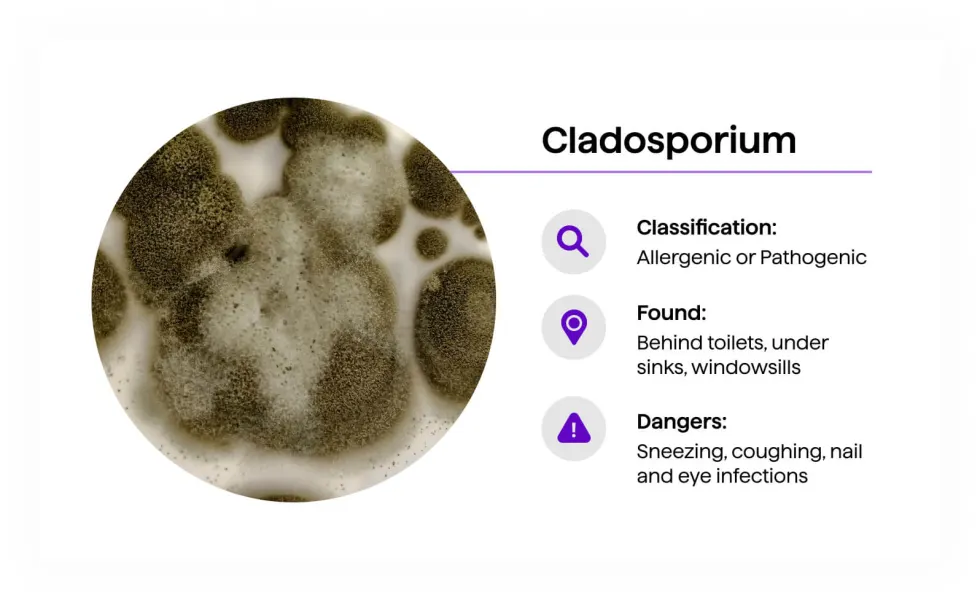
Cladosporium: olive green to dark brown, powdery or suede-like texture. The most common outdoor mold in Colorado, often found indoors on windowsills and wood surfaces.
Classification: Allergenic or Pathogenic · Found: Windowsills, wood, insulation, fabrics, behind toilets, under sinks · Health risks: Sneezing, coughing, nail and eye infections
Cladosporium is the most common outdoor mold in Colorado, and it moves indoors easily. It grows at cooler temperatures than most molds, so it stays active during Colorado’s cool spring and fall months when other species slow down. In local homes it takes hold on windowsills where water droplets form on cold glass, on wood in poorly vented attics, and anywhere organic material stays damp on and off.
Aspergillus
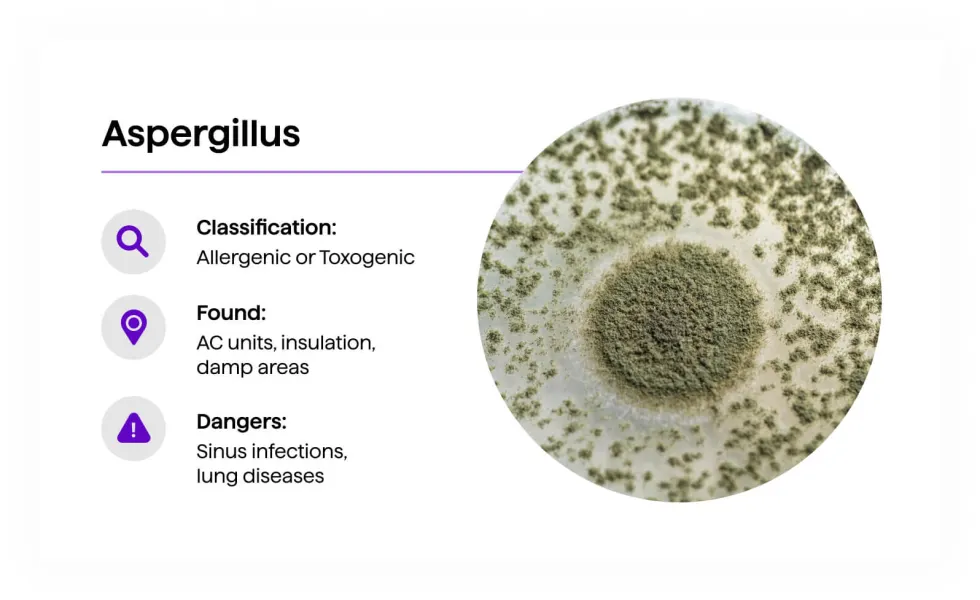
Aspergillus: powdery texture, usually green but appears in many colors. Found in heating and cooling systems and damp areas throughout Colorado homes.
Classification: Allergenic or Toxigenic (species-dependent) · Found: HVAC ducts, AC coils, insulation, humidifiers, damp areas · Health risks: Sinus infections, lung irritation; serious lung disease in immunocompromised individuals
Aspergillus covers hundreds of species and is one of the most common indoor molds in the world. It can grow with very little moisture, which matters in Colorado where other molds struggle. In Colorado Springs homes, the main places it takes hold are heating and cooling parts and the water panels inside whole-home humidifiers. Replace the humidifier panel each fall when you start the heat.
Alternaria
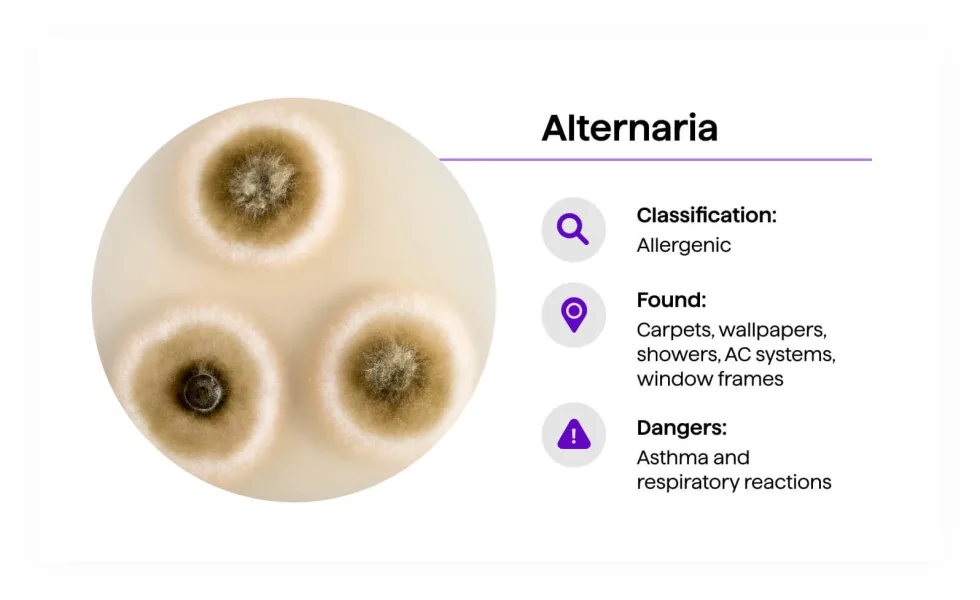
Alternaria: dark olive-brown, woolly texture with circular colony growth. The leading cause of mold allergies in Colorado, peaking during the summer monsoon (July to September).
Classification: Allergenic · Found: Carpets, wallpaper, showers, AC systems, window frames · Health risks: Asthma and breathing reactions. This is the leading mold allergen in Colorado.
Alternaria is mainly an outdoor mold, but it moves indoors easily. A 2011 Quest Diagnostics allergy study ranked Denver a top-10 worst U.S. city for mold allergies, driven largely by Alternaria. In Colorado Springs it spikes during the summer monsoon (July to September), when outdoor humidity climbs. Indoors, you find it in damp bathroom corners, under sinks, and in basements with humidity problems.
Aureobasidium
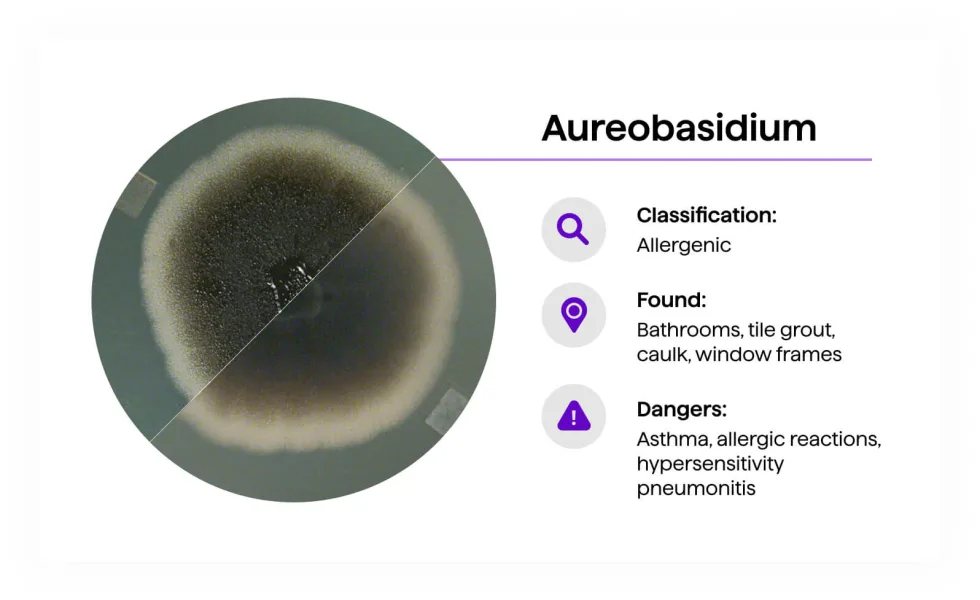
Aureobasidium: ranges from pink-brown when young to dark greenish-black as it matures. The most common mold found on bathroom grout and caulk in Colorado Springs homes.
Classification: Allergenic · Found: Bathroom tile grout, caulk lines, window frames · Health risks: Asthma, allergic reactions, and hypersensitivity pneumonitis (a lung inflammation triggered by breathing in mold)
Aureobasidium is almost certainly what’s growing on your shower grout and caulk. It starts pinkish-brown and darkens to near-black as it grows, which is why homeowners often mistake it for Stachybotrys. It lives on the surface and responds to proper cleaning and grout sealing. Colorado Springs city water is soft to moderately hard, about 1.3 to 2.8 grains per gallon, so mineral buildup is less of an issue here than in many cities. If your home is on a private well instead, common in Black Forest, Falcon, and Monument, the water can be genuinely hard, and mineral deposits in unsealed grout give this mold an ideal place to grow. Sealing the grout breaks the cycle either way.
Penicillium
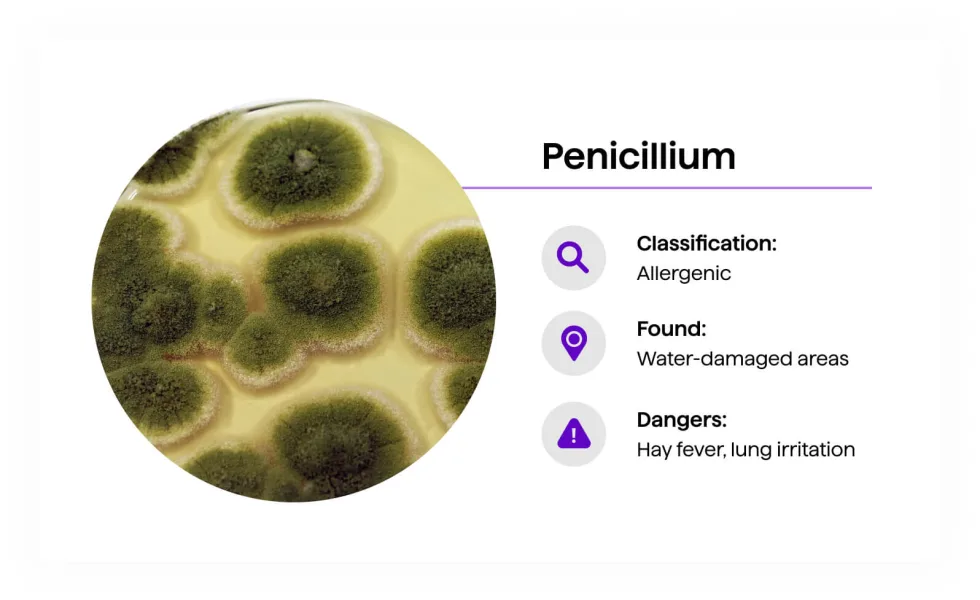
Penicillium: distinctive circular green colonies with ring patterns. Spreads fast and is common in any area with past water damage.
Classification: Allergenic · Found: Water-damaged drywall, insulation, carpet, wallpaper · Health risks: Hay fever, lung irritation, chronic sinus issues
Penicillium spreads fast once it takes hold, and it’s common in any Colorado Springs home with past water damage: a leaky window, an old roof problem, or a bathroom with poor ventilation. Unlike surface mildew, Penicillium sinks into porous materials. That means you have to remove the material it’s in, not just clean the surface.
Chaetomium
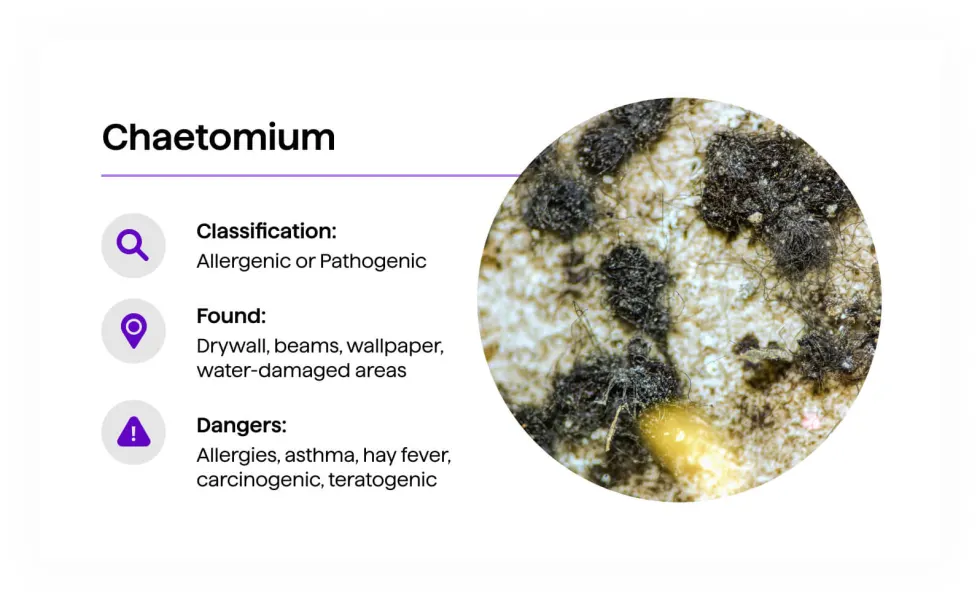
Chaetomium: dark, hairy, cotton-like texture found on water-damaged drywall and structural wood. It points to a history of serious water intrusion.
Classification: Allergenic or Pathogenic · Found: Drywall, structural beams, wallpaper, water-damaged areas · Health risks: Allergies, asthma, hay fever; some species considered carcinogenic at high exposure
Chaetomium grows on materials rich in cellulose (plant fiber) after a serious water leak: drywall, wood, and wallpaper. It’s easy to spot, with a dark, cotton-like look and visible hair-like strands. In Colorado Springs it shows up in homes with past roof leaks, basement flooding, or long-running plumbing failures. When you see it, the material underneath is damaged badly enough that it has to be removed, not just cleaned.
Acremonium
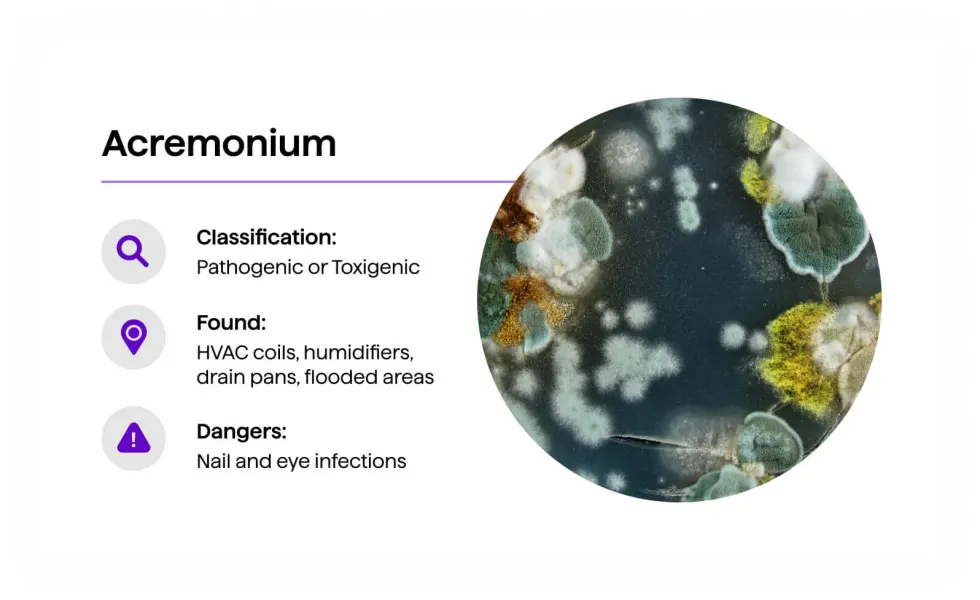
Acremonium: white or gray when young, gaining color over time. Found in the drain pans of heating and cooling systems and in humidifiers, equipment common in Colorado Springs' dry climate.
Classification: Pathogenic or Toxigenic · Found: HVAC coils and drain pans, humidifiers, window sealants, flooded areas · Health risks: Nail and eye infections; systemic infection risk for immunocompromised individuals
Acremonium matters in Colorado Springs because it takes hold in whole-home humidifiers and in the drain pans of heating and cooling systems, equipment that’s common here because of our dry climate. A neglected humidifier water panel is a reliable place for it to grow. Replace the panel each fall when you start the heat.
Fusarium
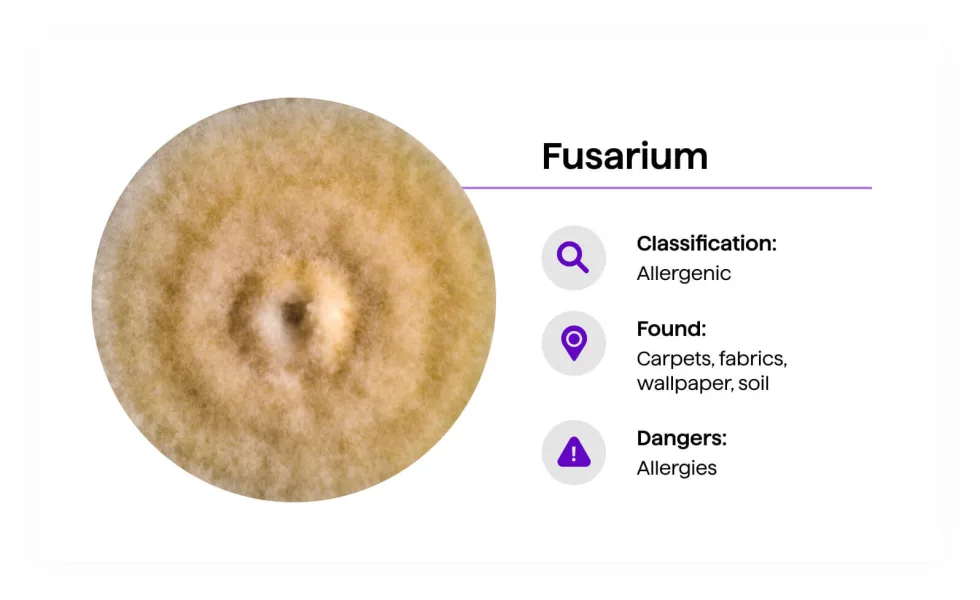
Fusarium: tan to brown, and linked to soil. Grows at colder temperatures than most molds, so it stays active in Colorado during months other species are dormant.
Classification: Allergenic · Found: Carpets, fabrics, wallpaper, and soil (often tracked in from outside) · Health risks: Allergies, skin and eye irritation
Fusarium comes into homes on shoes and through moving air. It grows at colder temperatures than most molds, so it stays active in Colorado during seasons when others are dormant. It’s most common in carpeted entryways and in basement spaces that touch soil. The main way to control it is regular vacuuming with a HEPA filter (a fine filter that traps tiny particles like spores).
Mucor
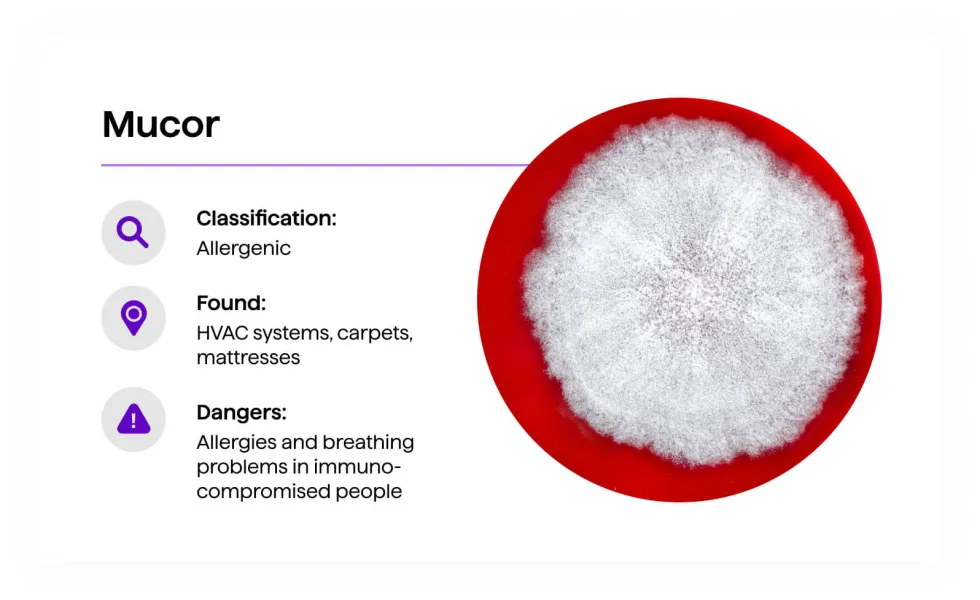
Mucor: white to gray, dense and fluffy. Grows fast when conditions allow. Found in heating and cooling systems and on damp organic material.
Classification: Allergenic · Found: HVAC systems, carpets, mattresses, decaying organic material · Health risks: Allergies and breathing problems, more serious in immunocompromised individuals
Mucor grows fast and turns up in heating and cooling systems that haven’t been serviced, in damp carpets, and on old mattresses in basement storage. It can grow at cooler temperatures, so it stays a concern during Colorado’s cold months. The best prevention is keeping your heating and cooling system serviced and getting rid of moisture sources.
Trichoderma

Trichoderma: bright green and fast-growing. Attacks damp wood and building materials, making enzymes that break down wood fiber and can weaken the structure.
Classification: Allergenic · Found: Damp wood, baseboards, carpets, wallpaper, damp building materials · Health risks: Severe allergies, lung infections, asthma
Trichoderma attacks damp wood and wood-based building materials. It makes enzymes that break down wood fiber, so it can weaken the structure if the moisture keeps up. In Colorado Springs homes it shows up on baseboards, on subflooring near plumbing leaks, and on wood framing in crawlspaces. Its bright green color stands out. If you see it, there’s an active moisture problem that needs to be fixed.
Ulocladium

Ulocladium: dark brown to black, smooth rounded colonies. Needs a lot of moisture to take hold, so you find it after flooding and serious water intrusion.
Classification: Allergenic · Found: Flooded areas, kitchens, basements, highly damp surfaces · Health risks: Respiratory issues, asthma, hay fever
Ulocladium needs a lot of moisture to take hold, so it’s less common in Colorado Springs than in humid places. It shows up after major water events: basement flooding, dishwasher failures, and long roof leaks. It’s often found next to Stachybotrys in badly water-damaged buildings because the two need the same wet conditions. If you see it, the water problem is more serious than everyday condensation.
Stachybotrys Chartarum: True Black Mold
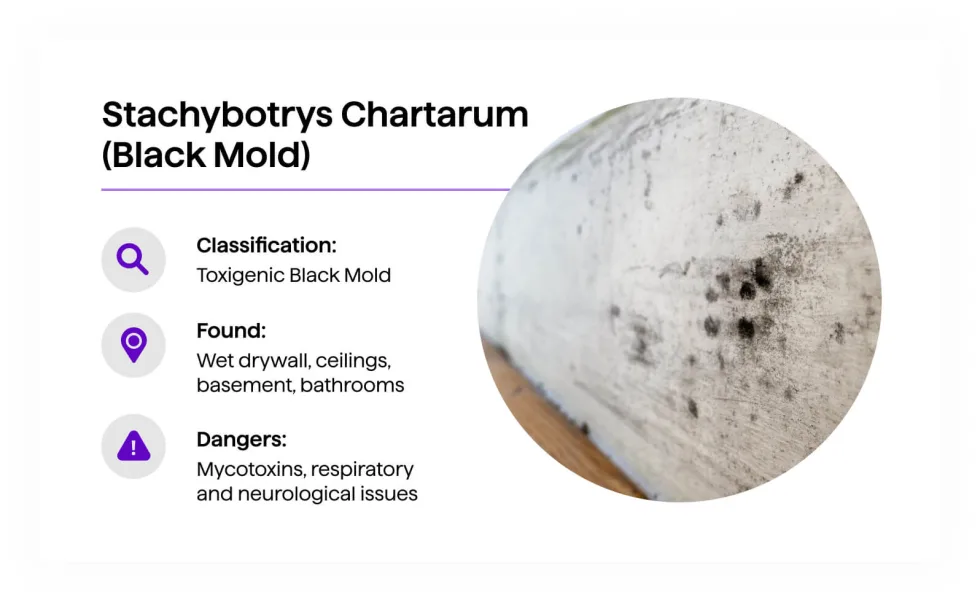
Stachybotrys chartarum on water-damaged drywall. Irregular, spreading dark patches with a slimy look when wet, clearly different from the neat circular colonies of other molds. It needs steady water intrusion to take hold.
Classification: Toxigenic · Found: Wet drywall, ceiling tiles, basements, and areas with long-term water damage · Health risks: Makes mycotoxins (mold toxins); breathing and nervous-system symptoms at high exposure
A few things worth knowing that media coverage omits:
The CDC’s position is that Stachybotrys should be treated like any other mold: remove it and fix the moisture source. No test proves a link between Stachybotrys and specific health symptoms. The 1990s panic started with a CDC report that was later withdrawn, after a second review could not confirm the link to infant deaths. Major health groups, including the CDC, the WHO, and the American Academy of Allergy, Asthma and Immunology (AAAAI), agree on this: Stachybotrys can cause allergy and breathing symptoms, but the evidence that normal indoor exposure causes serious poisoning is still unclear.
Even so, when it’s present, it always points to a serious, long-running water problem that needs professional cleanup, no matter how the health-risk debate shakes out.
What it actually looks like: Dark greenish-black, and slimy or jelly-like when wet. Irregular patches with different shades: lighter at the younger, spreading edges, and darker at the older center. A strong musty, earthy smell that hits you as you walk in. It grows on paper-faced drywall, wood, and ceiling tile, not on ceramic, glass, or other non-porous surfaces.
In 15 years of Colorado remodeling: I’ve found it once, behind drywall in a basement with a hidden sewer backup that had run for a long time. The conditions were unmistakable before I opened a single wall.
What’s Actually on Your Shower Grout?
The black stuff on your grout is almost certainly Aureobasidium (it’s the one I get asked about the most), a surface mold that darkens as it grows and responds to proper cleaning. The flat, powdery gray growth is surface mildew. Neither one is Stachybotrys.
Bleach test: Put a drop of household bleach on it. If it lightens within 1 to 2 minutes, it’s mold or mildew. Dirt won’t change color.
Texture test: Mildew is flat and powdery. Mold is raised and either fuzzy or slimy. Stachybotrys in particular is slimy, not powdery, and it grows on drywall and wood, not on tile.
Return test: Surface mildew cleaned off unsealed grout comes back because the grout is still porous. If mold returns after cleaning even though you’ve fixed the moisture you can see, that points to a hidden colony behind the surface.
What to Do
Surface mildew and Aureobasidium on grout: Scrub on an oxygen bleach paste with a grout brush (my go-to fix for this), cover it with plastic wrap, and leave it 4 to 8 hours. Rinse. Once it’s dry, apply a penetrating grout sealer (one that soaks in to block water). The sealer breaks the cycle. If your home is on a private well with hard water, common in Black Forest, Falcon, and Monument, unsealed grout is a guaranteed repeat problem.
Small, contained mold on non-porous surfaces (under 10 sq ft): Wear an N95 mask, nitrile gloves, and eye protection. Use a mold-killing cleaner. Fix the moisture source. EPA guidance supports doing this yourself at this size on non-porous surfaces.
Mold on drywall or wood: Drywall with mold usually has to be removed. You cannot surface-clean mold out of paper-faced drywall once it has soaked in. Cut out and replace the affected sections. Treat the wood framing (the studs) with a borax solution before you close the wall back up.
Call a professional when: the area is bigger than 10 square feet, there’s a musty smell with no visible source, there’s mold in the heating and cooling system or ductwork, the home has a history of major water intrusion, or anyone in the household has a breathing condition or a weakened immune system.
For mold found during a bathroom or remodel project in Colorado Springs, call (719) 243-9718. If the mold turns out to be behind tile or in a failing shower, that’s a job for our bathroom remodel service in Colorado Springs.
Sources: CDC Mold Health (cdc.gov/mold-health); CDC Facts About Stachybotrys chartarum; Colorado Allergy and Asthma Centers; WebMD Mold Reference. Mold identification images sourced from mold reference library.
Questions people ask
Does true black mold (Stachybotrys) grow in Colorado Springs homes?
Rarely, and only under specific conditions. Stachybotrys chartarum requires constant moisture and humidity above 90% to establish and grow. Colorado Springs indoor humidity runs 10–20% in winter, one of the least hospitable environments for Stachybotrys in the country. The mold found in most Colorado Springs homes is Cladosporium, Aspergillus, Alternaria, or Aureobasidium: all common, all manageable, and all very different from Stachybotrys.
What is the difference between mold and mildew?
Mildew is a surface fungus: flat, powdery, and usually white or gray. It grows on the surface of materials and wipes off with household cleaners. Mold penetrates into porous materials like drywall, wood, and grout. It has a raised, fuzzy, or slimy texture and comes in many colors. The practical difference: mildew is a cleaning problem; mold is a moisture problem with a surface symptom.
What does real black mold (Stachybotrys) look like?
Stachybotrys is dark greenish-black with a slimy or jelly-like texture when wet, very different from the flat, powdery mildew on bathroom tile. It grows in irregular patches on materials rich in cellulose (plant fiber) like paper-faced drywall, wood, and ceiling tile after long-term water intrusion. It has a strong musty, earthy odor. Color alone cannot confirm Stachybotrys. Only lab testing identifies the species for certain.
When should I call a professional for mold instead of handling it myself?
The EPA guideline: mold covering more than 10 square feet calls for professional cleanup. Call a professional for mold behind walls or under flooring, any musty smell without visible mold, mold in HVAC systems, or if anyone in the household has breathing problems or a weakened immune system. DIY is fine for contained surface mold under 10 square feet on non-porous surfaces with the right protective gear: an N95 mask, nitrile gloves, and eye protection.
Ready to Get Started?
Flat-rate written estimate, no hourly surprises. Serving Colorado Springs, Monument, Fountain, Woodland Park, and the Pikes Peak region.