
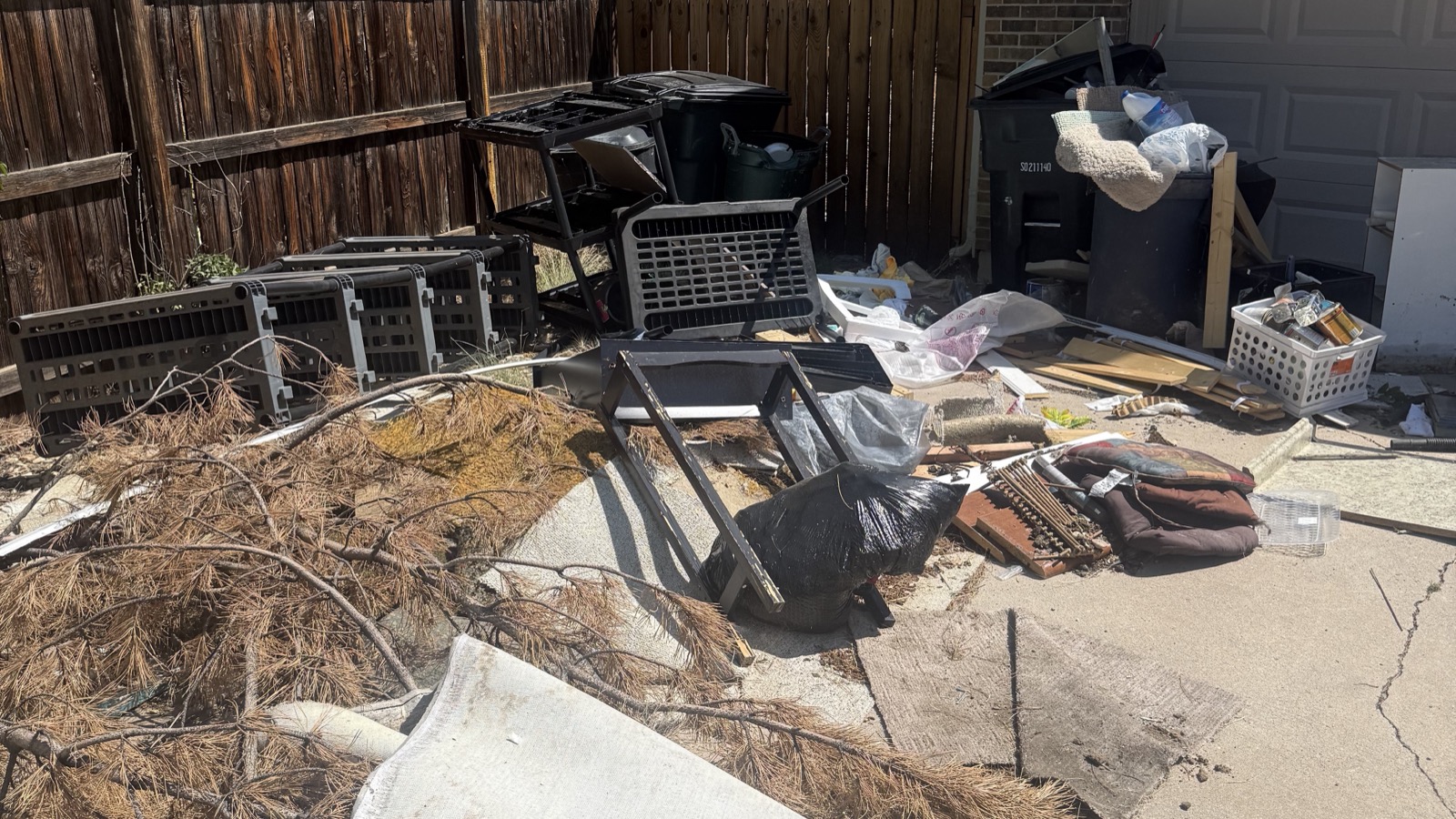
A post-eviction turnover on a three-bedroom Colorado Springs rental runs $1,500 to $3,500 when the damage is cosmetic, $4,000 to $8,000 once flooring and doors are involved, and $8,000 to $25,000 for a heavy turnover, more if water and mold get into it. That’s exactly what happened to the house behind the photo at the top of this page (I shot that pile in the driveway this week, right after the tenants were evicted). Colorado Springs sits at 6,035 feet, gets more than 100 freeze-thaw cycles a year, and drops to 10 to 20 percent indoor humidity in winter, so a vacant house here falls apart faster than almost anywhere else, and this one sat empty through the worst of it.
Inside was worse. Stair balusters (the upright posts that hold up the handrail) knocked loose and split at the base. Handrail chewed up down to bare wood. Carpet on the stairs ground so far past cleaning that the pattern is just stains now. And a basement that flooded when a water supply line burst while the house sat vacant, with nobody there to hear it. A supply line is the pipe that feeds a fixture like a sink or toilet (the first thing I check on any vacant-property walkthrough). The water stood for days, then mold set in. By the time anyone found it, the flooring, the bathroom walls, the basement walls, the doors, and the trim were all damaged. The whole basement had to be gutted and the mold removed.
The landlord did not do anything wrong, and I’ve seen this exact story play out more than once. They hired a property manager, they screened the tenants, they collected a deposit. And they still ended up with a five-figure renovation and a hard decision about whether filing an insurance claim would cost them their policy.
If you own rental property in the Pikes Peak region, this is the scenario I want you to understand before it happens to you. Here’s what it actually costs, what the law lets you recover, and where the money goes.
The short version: as of July 2026, a post-eviction turnover on a three-bedroom Colorado Springs rental runs roughly $1,500 to $3,500 if the damage is cosmetic, $4,000 to $8,000 if flooring and doors are involved, and $8,000 to $25,000 when the house needs a full cleanout plus flooring, trim, and drywall throughout. Add water intrusion and mold and the range moves to $25,000 to $45,000. Colorado caps the security deposit at one month’s rent, so recovery through the deposit covers a small fraction of a heavy turnover. Prevention, documentation, and leak detection carry far more financial weight than anything you can withhold after the fact.
What Colorado Landlord Tenant Laws Apply After an Eviction?
Colorado requires cause to evict, gives most tenants a 10-day window to cure before you can file, and caps security deposits at one month’s rent. Those three facts set the outer limit on what you can recover after a tenant destroys a rental, so know them before you build a repair budget. I’m not your lawyer, so take this as a working summary for that purpose, not legal advice. Colorado landlord tenant law changed substantially in 2024 and again in January 2026, and anyone holding rental property here should read the current statutes in full or sit down with a real estate attorney. But you cannot plan a repair budget without knowing what the runway looks like, so here is the shape of it.
Colorado changed significantly for landlords in 2024. HB24-1098, signed in April of that year, requires cause to evict or to decline renewal on most residential tenancies. Nonpayment of rent, a material lease violation, a substantial (criminal) violation, and nuisance all qualify. A no-fault termination that fits one of the statutory exceptions requires 90 days’ notice.
For the common cases, nonpayment and lease violation, the notice is a 10-day demand for compliance or possession. If the tenant does not cure or leave, you file a Forcible Entry and Detainer (FED) action, in El Paso County through the 4th Judicial District. Realistically, from the first notice to a writ of restitution (the court order that lets the sheriff remove the tenant) and the actual move-out, most contested evictions run six to ten weeks. Uncontested ones move faster. Either way, you are not collecting rent during that window, and the house is deteriorating the entire time.
Eviction volume in Colorado has been climbing. Statewide filings passed 25,000 by early August 2024, roughly 10 percent ahead of the prior year’s pace. This is not a rare event anymore.
Then there is the deposit, and this is where a lot of Colorado landlords are about to get surprised.
C.R.S. 38-12-103 has always required the deposit back within 30 days (up to 60 if the lease specifies), with willful withholding exposing you to treble damages plus attorney fees. But HB25-1249, effective January 1, 2026, tightened it considerably:
- Security deposits are now capped at one month’s rent. You cannot collect more up front.
- You cannot withhold for normal wear and tear, or for anything that preexisted the tenancy. The statute also broadened what counts as normal wear and tear to include things like carpet buckling, wall scuffs, and general deterioration from ordinary use.
- You cannot charge a tenant for damage that was not documented at inspection.
- If a tenant asks, you have 14 days to hand over all supporting documentation you hold: photos, inspection forms, receipts, invoices, estimates.
- Carpet cannot be charged against the deposit unless the damage is substantial, did not preexist, and the carpet was not already replaced within the prior 10 years. Interior repainting carries similar restrictions.
- Miss the deadline or the required notices and you waive the right to retain any of it.
The practical takeaway: photograph everything, before and after, with dates. Keep the receipts. Keep the estimates. A move-in condition report with photos is now the single most valuable document in your file. And understand that on a house like the one above, the deposit is going to cover a rounding error’s worth of the total. One month’s rent against a $20,000 renovation is not a recovery plan.
What Does Junk Removal Actually Cost in Colorado Springs?
Budget $1,200 to $2,500 to empty a three-bedroom Colorado Springs house after an eviction, including a 20-yard roll-off dumpster at $490 to $650, labor, and disposal fees. Before a single repair starts, the house has to be emptied. This is the step I see landlords underestimate most, because it looks like a weekend of hauling and it is almost never a weekend of hauling.
Junk removal service: the national range is $140 to $400 for partial loads, with a full truckload (roughly 360 to 480 cubic feet) running $400 to $800. A house like the one pictured is not one truckload. Interior furniture, mattresses, appliances, yard debris, and construction demo from the mitigation work together typically run two to four loads.
Roll-off dumpster: in Colorado Springs, a 20-yard roll-off currently runs $490 to $650 for a standard rental period, with sizes across the range landing between roughly $483 and $794. A 20-yard holds about eight pickup loads. For a full-house cleanout plus demo debris, a dumpster on site is usually the cheaper path than repeated service calls, and it lets the demo and the cleanout happen at the same time instead of sequentially.
Watch for the surcharges, because they are where dumpster quotes go sideways:
- Mattresses and box springs carry per-item fees at most El Paso County transfer stations.
- Appliances with refrigerant (fridges, freezers, window AC units) require certified recovery and cannot go in a mixed load.
- Tires, paint, solvents, and electronics are separate streams. The El Paso County household hazardous waste facility takes most of it, but it is a trip, not a pickup.
- Overweight loads. Concrete, tile, and wet carpet are heavy. Wet carpet in particular weighs several times what dry carpet does, and a dumpster that goes over tonnage gets billed by the ton on top of the rental.
Realistic budget for a full post-eviction cleanout on a three-bedroom Colorado Springs house: $1,200 to $2,500 including dumpster, labor, and disposal fees. Add the yard if it was neglected, which it usually was.
The Water Damage Multiplier
Water that runs unnoticed for days in a vacant house turns a plumbing repair into a renovation. Mitigation, meaning the emergency water removal and drying, runs $3 to $7.50 per square foot, and mold remediation (the cleanup and removal of mold) in a finished basement runs $18 to $28 per square foot. The variable is not the leak. It is how long it ran. A burst supply line in an occupied house is a bad afternoon. A burst supply line in a vacant house is a renovation.
The difference is time. Water that runs for hours gets extracted and dried. Water that runs for days soaks the slab, wicks up the drywall, saturates insulation, gets under the flooring, and by the time anyone opens the door there is visible growth. Colorado’s dry air (10 to 20 percent indoor relative humidity in winter) helps a little on the drying side, but it does nothing once moisture is trapped behind drywall and under LVP (luxury vinyl plank flooring).
Current cost ranges:
| Work | Cost |
|---|---|
| Water damage restoration, national average | ~$3,867 (typical range $1,384–$6,384) |
| Mitigation only (extraction + drying) | $3–$7.50 per sq ft |
| Repair and rebuild after mitigation | $20–$37 per sq ft |
| Mold remediation, unfinished basement | $10–$20 per sq ft |
| Mold remediation, finished basement | $18–$28 per sq ft |
| Mold remediation, typical whole job | $1,200–$3,750 |
The finished basement premium is not a markup. It is demo. Crews have to pull baseboard, cut drywall back above the water line, remove insulation from the stud bays, lift and dispose of flooring and pad, and treat the framing and slab before anything goes back. On a 900 square foot finished basement, remediation alone can run $16,000 to $25,000 before a single new piece of drywall goes up.
After mitigation, you are rebuilding: new subfloor prep, flooring, baseboard, drywall, texture, paint, and often a new shower if the pan (the waterproof base) or the surround (the walls) was involved. In Colorado Springs, budget $6 to $12 per square foot for basement flooring installed depending on material, plus $4,000 to $9,000 for a standard shower rebuild with tile.
On the insurance question
A lot of landlords in this exact position freeze up, and the fear is legitimate. Non-weather water damage is the single most common homeowner claim type, carriers in Colorado have been tightening aggressively, and a claim history absolutely factors into renewal decisions in a state with our hail loss ratios.
I am a contractor, not an insurance advisor, so take this as a framing rather than advice: get a written scope and estimate from a licensed contractor before you call the carrier. Once you have a real number, you can compare it against your deductible and make an informed decision instead of a fearful one. Plenty of these jobs come in close enough to the deductible that filing was never worth it, and you only learn that by getting the number first. If the number is $25,000, that is a different conversation, and one worth having with an independent agent who can tell you what a claim actually does to your future premiums and coverage.
Interior Damage: What Does Each Line Item Run?
Interior doors run $250 to $450 each installed, baseboard $3.50 to $7 per linear foot, drywall patches $75 to $600, and a full stair railing rebuild $1,800 to $4,500. A post-eviction house rarely needs one of anything.
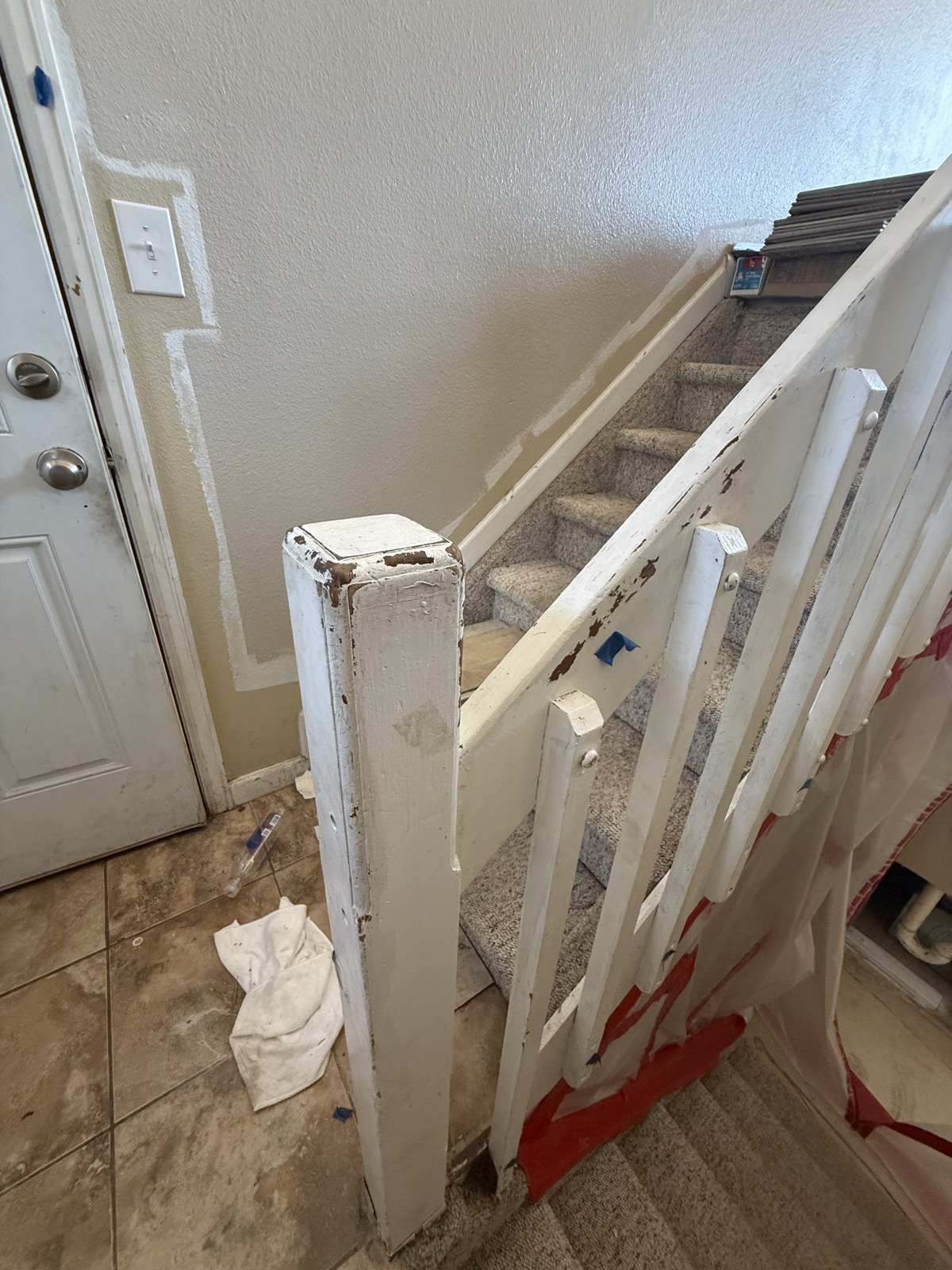
This is the stair railing from the same house. Balusters split at the base, handrail gouged through the finish, and the newel post (the thick main post at the end of the railing) loose in the floor. This is not wear and tear. Wear and tear is a scuffed handrail. This is impact damage.
Here is what the individual pieces cost in the Colorado Springs market, installed:
Doors and trim
- Prehung interior door replacement (the door comes already mounted in its frame), painted: $250–$450 each
- Door hardware replacement: $40–$120 per opening
- Baseboard replacement: $3.50–$7 per linear foot installed
- Door and window casing: $4–$9 per linear foot installed
- Full trim package, 1,800 sq ft house: $3,500–$7,000
A post-eviction house rarely needs one door. It needs six, because holes get punched, hinges get torn out, and slabs get kicked. Once you are replacing more than two or three in a run, replacing the whole set is often the better call, because a mismatched door in a hallway is visible to every prospective tenant who walks through.
Stairs and railing
- Individual baluster replacement: $35–$75 each installed
- Handrail replacement and refinish: $400–$1,200 per run
- Newel post reset or replacement: $200–$600
- Full stair railing rebuild: $1,800–$4,500
Drywall
- Small patch (fist hole, door knob): $75–$200 each
- Large patch (over 2 sq ft, texture match): $250–$600
- Full sheet replacement with texture and paint: $400–$900 per room
Texture matching is the part homeowners underestimate, and it is the single most common reason a drywall repair reads as a patch instead of a wall. Colorado Springs builders used knockdown, orange peel, and skip trowel textures (different wall-texture styles) across different eras and subdivisions, and a patch that does not match the surrounding texture reads as damage even after paint. These are market ranges from drywall contractors. I no longer patch drywall myself, but on a full turnover a drywall contractor handles that part and I coordinate it with the other trades.
Paint
- Interior repaint, whole house, 2,000 sq ft (walls, ceilings, trim): $5,900–$10,800, or $3,900–$7,850 for walls only (painting and finishes)
- Single room, walls only (10x12): $300–$500, or $500–$1,200 with ceiling and trim
- Priming over smoke, pet, or water staining: add 20–35 percent
Remember the deposit rule here: under the 2026 statute you cannot automatically charge repainting to a departing tenant. Repaint on turnover is a cost of doing business unless the damage is genuinely beyond wear and tear and documented as such.
Flooring
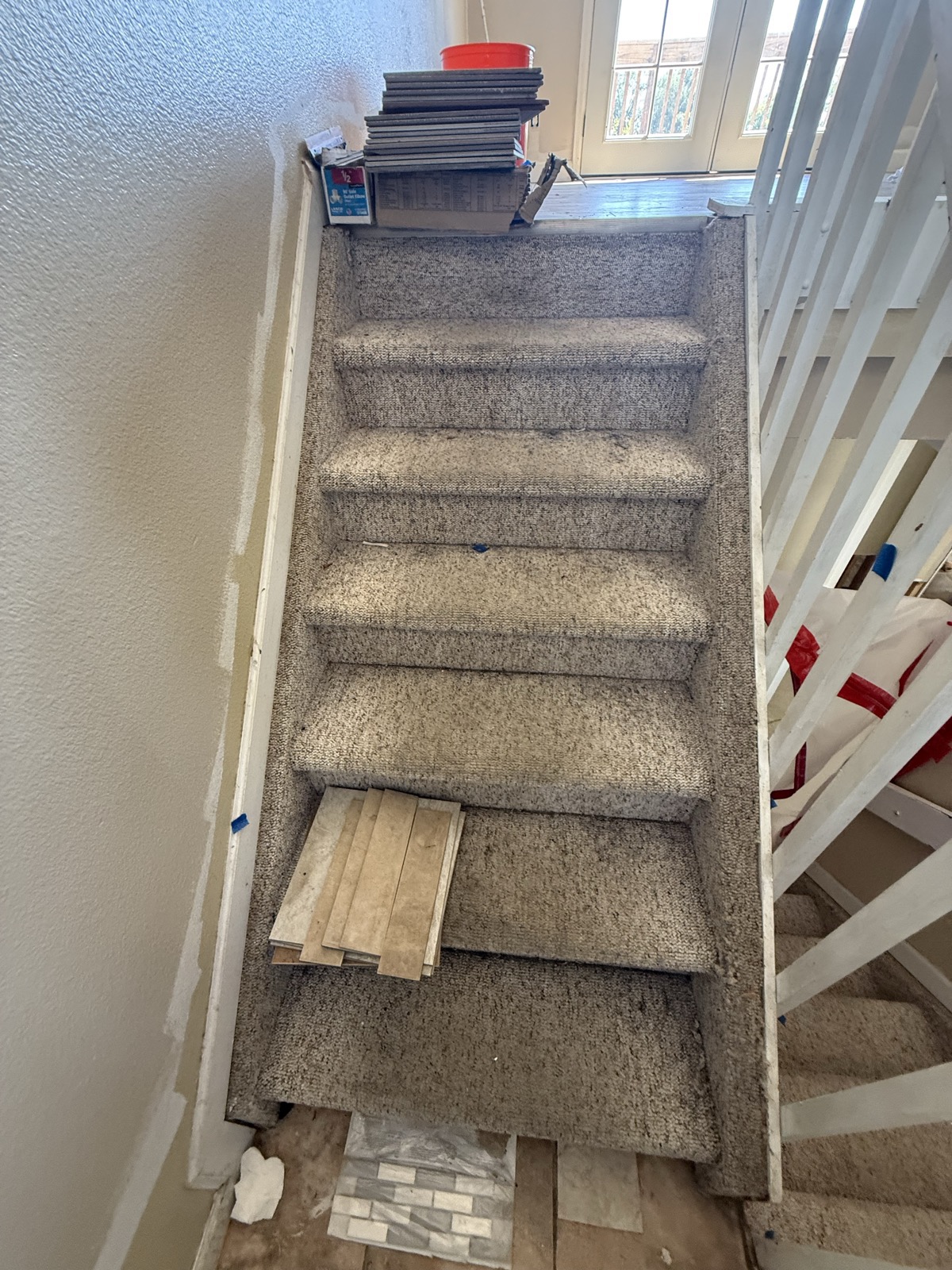
That carpet is not dirty. It is finished. There is a point past which extraction cleaning is money spent to confirm that the carpet needs replacing, and pet contamination that reached the pad and subfloor is always past it.
- Carpet and pad, installed: $3.50–$6.50 per sq ft
- Stair carpet, installed: $12–$25 per stair
- LVP, installed: $5–$9 per sq ft
- Subfloor sealing after pet contamination: $0.75–$1.50 per sq ft
- Subfloor replacement, water or rot damage: $4–$8 per sq ft
If you are choosing new material for a rental rather than matching what was there, durability matters more than looks. Our guide to flooring for Colorado homes covers what holds up at altitude and under tenant use.
The subfloor sealing line is the one people skip and then regret. If urine reached the pad, it reached the subfloor. New carpet over an unsealed contaminated subfloor smells within a month of the first warm day.
The Realistic Total
A post-eviction turnover on a three-bedroom, 1,800 square foot Colorado Springs rental runs $1,500 to $3,500 for cosmetic damage, $4,000 to $8,000 when flooring and doors are involved, $8,000 to $25,000 for a heavy turnover, and $25,000 to $45,000 once water and mold enter the picture. Putting the ranges together:
| Scenario | Scope | Cost |
|---|---|---|
| Light turnover | Paint, carpet clean, minor patching, hardware | $1,500–$3,500 |
| Moderate | Above plus carpet replacement, 3–4 doors, trim repair | $4,000–$8,000 |
| Heavy post-eviction | Full cleanout, flooring throughout, doors and trim replaced, extensive drywall, full repaint | $8,000–$25,000 |
| Heavy plus water event | All of the above plus mitigation, mold remediation, basement rebuild, shower replacement | $25,000–$45,000 |
Against a deposit of one month’s rent. That is the actual math, and it is why the documentation and the prevention side matter more than the recovery side.
What Actually Protects You From Rental Damage Losses?
Quarterly interior inspections, timestamped move-in photos, and a leak-detection shutoff prevent far more loss than anything you can recover from a deposit after the fact. In that order.
Inspect quarterly, in person. Not a drive-by. A property manager who has not been inside the unit in eight months is not managing the property. A burst line, a running toilet, a pet that was never disclosed, and a slow accumulation of junk are all visible early and all cheap early.
Photograph move-in condition, every room, timestamped. Under the 2026 rules, the burden is on you to prove damage did not preexist. No photos means no withholding.
Install a leak detection shutoff. A smart water shutoff with leak sensors runs $500 to $1,200 installed and it is the highest-ROI device you can put in a rental. The house in these photos flooded while vacant. A $600 device would have closed the valve and saved a five-figure remediation. That math is not close.
Winterize between tenancies. A vacant house in Colorado Springs still gets 100-plus freeze-thaw cycles a year and 40-degree daily swings. If it is going to sit through a winter, keep heat at 55 minimum, or drain the system properly.
Sequence the repairs correctly. Cleanout, then mitigation and drying, then demo, then rough repairs, then interior remodeling finishes. Landlords lose real money by starting paint or flooring before the moisture problem is fully resolved, and then paying twice.
Get one contractor for the whole scope. Chasing the lowest bid on each trade is how these projects go sideways, and what cheap contractors actually cost you applies double when the work is hidden behind new drywall. I’ve watched landlords save a little upfront and lose a lot more in vacancy time chasing five separate schedules. Coordinating a junk hauler, a mitigation company, a flooring installer, a painter, and a trim carpenter separately means five schedules, five invoices, and every gap between trades costs you another week of vacancy. A single flat-rate scope for the rebuild portion removes the coordination cost and gives you one number to compare against your deposit, your reserves, and your deductible.
Post-eviction turnovers are ugly, expensive, and more common in El Paso County every year. They are also finite. The house in these photos will rent again, and it will rent for more than it did before, because everything in it will be new.
If you’re staring at a rental that came back destroyed, the first thing I’d tell you is get an honest written scope so you know what you’re actually dealing with. Call (719) 243-9718 for a walkthrough and a flat-rate estimate on the repair work. Licensed, insured, and no hourly surprises while your unit sits vacant.
Questions people ask
How much does it cost to repair a rental property after an eviction in Colorado Springs?
A light turnover (paint, carpet cleaning, a few drywall patches) typically runs $1,500 to $3,500. A moderate turnover with damaged doors, trim, and one flooring replacement runs $4,000 to $8,000. A heavy post-eviction turnover involving full junk removal, flooring replacement in multiple rooms, door and trim replacement throughout, and a bathroom rebuild commonly lands between $8,000 and $25,000. Add water intrusion and mold remediation and the total can exceed $30,000 on a single-family home.
Can a Colorado landlord keep the security deposit for tenant damage?
Yes, for damage beyond normal wear and tear, but the rules tightened on January 1, 2026 under HB25-1249. Security deposits are capped at one month's rent. Landlords must return the deposit within 30 days (up to 60 if the lease says so), cannot withhold for normal wear and tear or preexisting conditions, cannot charge for damage that was not documented at inspection, and must hand over supporting documentation including photos, inspection forms, receipts, invoices, and estimates within 14 days of a tenant's request. Carpet replacement cannot be charged unless the damage is substantial and the carpet was not already 10 or more years old. Missing the deadline waives the right to withhold anything, and willful withholding exposes the landlord to treble damages plus attorney fees under C.R.S. 38-12-103.
What changed in Colorado landlord tenant laws for 2026?
Two laws drive the current picture. HB24-1098, effective April 2024, requires cause to evict or to decline renewal on most residential tenancies, with a 10-day demand for compliance on nonpayment and lease violations and 90 days' notice for qualifying no-fault terminations. HB25-1249, effective January 1, 2026, overhauled the security deposit statute: deposits are capped at one month's rent, the definition of normal wear and tear was broadened to include carpet buckling and wall scuffs, landlords cannot charge for undocumented damage, and supporting documentation must be produced within 14 days of a tenant's request. Landlords must also disclose known structural issues including mold, water, fire, and roof condition before lease signing.
How much does junk removal cost after a tenant leaves a house full of debris?
A full junk removal truckload of roughly 360 to 480 cubic feet runs $400 to $800, and a post-eviction house typically needs two to four loads. In Colorado Springs, a 20-yard roll-off dumpster runs $490 to $650 for a standard rental period, and holds about eight pickup loads. For a full-house cleanout combined with demolition debris, the dumpster is usually cheaper than repeated service calls. Budget $1,200 to $2,500 total for a three-bedroom cleanout including dumpster, labor, and disposal fees. Watch for surcharges on mattresses, refrigerant appliances, tires, paint, and electronics, and for overweight loads caused by wet carpet, tile, or concrete.
How much does mold remediation cost in a flooded basement?
Unfinished basements run $10 to $20 per square foot because crews can reach the affected concrete and framing directly. Finished basements run $18 to $28 per square foot because drywall, insulation, baseboard, and flooring have to come out before treatment begins. National averages for mold remediation land between $1,200 and $3,750 for a typical job, and water damage restoration averages around $3,867. A burst supply line that ran unnoticed in a vacant house is usually at the high end of both ranges.
What is the eviction notice period in Colorado?
Since HB24-1098 took effect in April 2024, most Colorado residential landlords need cause to evict or decline to renew. For nonpayment of rent or a material lease violation, the standard notice is a 10-day demand for compliance or possession. For a no-fault termination that qualifies under the statute, 90 days' notice is required. If the tenant does not comply or leave, the landlord files a Forcible Entry and Detainer (FED) case in county court, in El Paso County through the 4th Judicial District.
Ready to Get Started?
Flat-rate written estimate, no hourly surprises. Serving Colorado Springs, Monument, Fountain, Woodland Park, and the Pikes Peak region.