
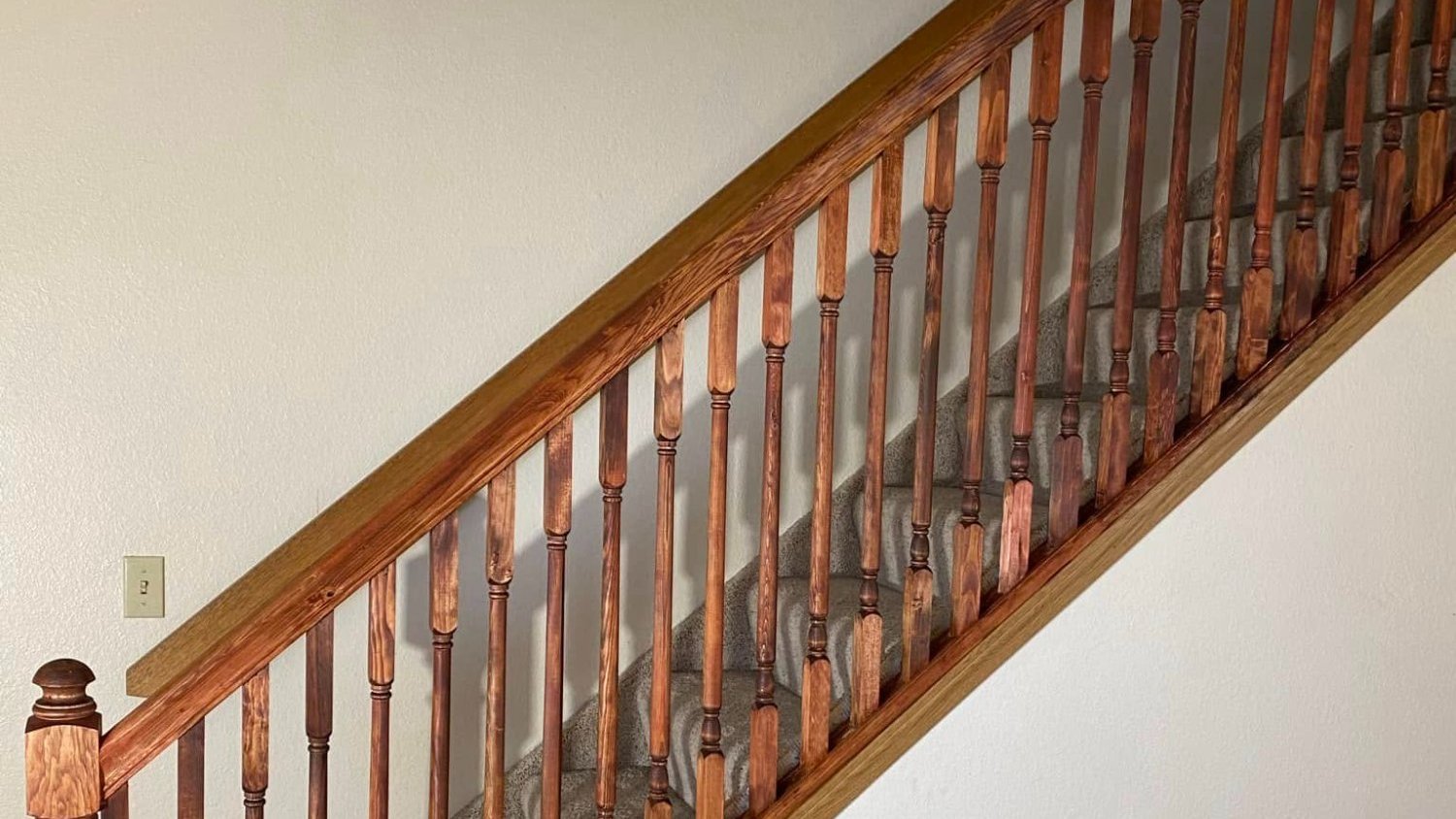
A stair railing replacement in Colorado Springs runs $800 to $2,500 for a standard wood railing (new newel posts, balusters, and handrail), $1,500 to $4,000 for a wood-and-iron mix, and cable starts around $3,500. Inspectors here check every stair railing against the 2021 International Residential Code, which PPRBD lists as its adopted residential code. Indoor winter air here sits at 10 to 20 percent humidity, and that dry air is why so many wood balusters I get called to look at have gone loose and rattly at the glue joints. The photo above is a townhome railing I stained here in Colorado Springs, and it’s a good picture of what a tight, finished wood railing looks like.
Is Cable Railing Better Than Traditional Balusters?
Cable railing isn’t better than balusters, it’s different: cable wins on looks and sightlines, while vertical balusters win on cost, repairability, and child safety. Cable runs about $50 to $250 per linear foot installed, against roughly $20 to $60 for wood balusters (national averages from HomeGuide’s stair railing cost data), and it needs stronger posts, because the tension in a tight cable run pulls sideways on every post.
Cable makes sense when you want an open, modern look (open-concept homes in Flying Horse and Wolf Ranch, mountain-modern builds, anywhere you want to see the staircase and the room beyond) and you’re willing to pay for heavier posts and tensioning hardware.
The “ladder” worry is real, but it’s a household decision, not a code rule. Horizontal cables give a small child toe-holds, the same way a ladder does. I don’t find a ladder-effect rule in the guard sections of the 2021 IRC, chapter 3. What the code does regulate is the opening between members, so a cable railing must still keep a sphere out of every gap. Cables flex when pushed, so many cable systems are spaced closer than the code limit (about 3 inches is common; that spacing is manufacturer and inspector practice, so check the spec sheet for your system). If you have kids under about five, or a stair where a fall would be a long one, I’ll tell you plainly to stay with vertical balusters, and I’ll say so up front when I walk the stairs.
What Does Stair Railing Replacement Cost in Colorado Springs?
A wood stair railing replacement runs $800 to $2,500 for a single straight flight, a wood-and-iron mix runs $1,500 to $4,000, and cable or fully custom work starts around $3,500. Those numbers cover the whole system on one flight: newel posts, balusters, handrail, and finishing. Wood species, baluster style, and stair shape (a turn or landing adds posts and angled cuts) move you around inside the range. Material costs in Colorado run slightly higher than national averages.
The per-foot market ranges below are national averages for installed railing, so use them to compare systems rather than as a quote. A staircase costs more per foot than a flat railing because every baluster is cut at the stair angle and every post has to be set plumb into the framing.
| System | Installed cost per linear foot (market range) | Best for |
|---|---|---|
| Wood balusters, wood handrail | $20–$60 | Most homes, easiest repair |
| Wrought iron balusters, wood handrail | $50–$100 | Wood warmth, lighter look |
| Cable or other metal systems | $50–$250 | Modern, open sightlines |
Sources: price ranges from HomeGuide and HomeGuide’s railing guide. I don’t tack extra onto a market range when I quote it here. For how I turn a range into a flat-rate number for your actual stairs, see how handyman pricing works in Colorado Springs.
Do I Need a Permit to Replace a Stair Railing in Colorado Springs?
Call PPRBD before you start, because a like-for-like swap in the same position is usually treated as a repair, while adding a railing or changing the stair structure typically needs a permit. PPRBD’s list of work exempt from permit names finish work such as painting, tile, and cabinets. It does not name guards or railings, and I won’t tell you it’s exempt when their own list doesn’t say so. The number is (719) 327-2880.
Even when no permit is pulled, the railing still has to meet the code, and a home inspector or buyer’s inspector will test it. I’ve seen failed railings flagged on pre-listing and rental inspections, and a loose or short railing is one of the cheaper items on that list to fix before it costs a sale.
What Are the Code Requirements for Stair Railings in Colorado Springs?
Stair railings here follow the 2021 International Residential Code, and these are the numbers I build to on every stair job. The IRC chapter 3 text covers handrails in section R311.7.8 and guards in R312. PPRBD’s Appendix C and local amendments can modify a section, so confirm on a permitted job.
Handrail height (R311.7.8): 34 to 38 inches, measured straight up from the sloped line along the stair nosing (the front edge of the tread, the part that sticks out past the riser below it). That’s a tighter window than most people expect. I’ve had homeowners ask me to raise it a couple of inches for looks, and I have to tell them no.
When a handrail is required (R311.7.8): on at least one side of any flight of stairs with four or more risers.
Guard height (R312.1.2): 36 inches minimum on landings, porches, and balconies. On the open side of a stair, the minimum is 34 inches, measured from the line along the tread nosings, so the guard lines up with the handrail beside it. A guard is the barrier on an open side that stops someone from falling off the edge.
Baluster gaps (R312.1.3): a 4-inch sphere can’t pass through any opening in a guard. On the open side of a stair, the code allows a slightly larger 4⅜-inch sphere, and the triangle formed by the riser, tread, and bottom rail must stop a 6-inch sphere. That’s a child-safety rule, and inspectors carry a gauge for it.
Continuity: the handrail has to run the full length of the stairs without a break. It can’t stop short at a decorative newel post partway down.
Graspability (R311.7.8.5): a round handrail has to measure between 1¼ and 2 inches across. A handrail that isn’t round has to measure between 4 and 6¼ inches around its outside edge. The wide, flat rail common in production-built homes often fails this test, because it’s too wide to close your hand around. If you’re planning stairs you want to use for decades, a rail you can actually grip matters, and it’s the same logic behind grab-bar planning in my aging-in-place bathroom guide. For the outdoor version of these rules, see deck handrail and guardrail requirements in Colorado Springs.
Getting the Terminology Straight
Balustrade: the complete railing system as a whole. It’s everything together: newel posts, balusters, handrail, and base rail.
Newel post: the large post that anchors the railing at the bottom, top, and any landing turns of the stairs. It’s the structural piece the whole system attaches to. Setting the newel posts solid is the foundation for everything else, and it’s the first thing I check on any job I walk into.
Balusters (also called spindles): the vertical pieces between the newel posts. They fill the open space and form the guard. They can be wood, in dozens of styles, or metal, or a mix of both.
Handrail: the rail you actually grab, running along the top of the balusters.
Base rail: the bottom horizontal piece the balusters attach to at tread level, on some systems.
Which Is Best Indoors: Wood, Steel, or Horizontal Line Railing?
Wood or a wood-and-iron mix is the best all-around choice indoors, and horizontal line railing (cable or flat bar) is the better pick when the look matters more than the budget. Pick the household needs first (small kids favor vertical balusters, and aging-in-place favors a graspable wood handrail), then the style.
Oak is the standard for good reason. It’s hard enough to hold up to daily contact, comes in every profile from simple to ornate, and it stains beautifully. For a stain-grade system, one where the wood grain shows through the finish, oak is the default.
Poplar is the right call when the system will be painted. It has a tighter grain, takes paint cleanly, and costs less than oak.
Hard maple, walnut, and hickory are step-up options for higher-end work. All three are hard enough to hold up to daily use, and all three cost more than oak but deliver noticeably more character.
Wrought iron and powder-coated steel balusters are the most popular upgrade in Colorado Springs right now. The hybrid system (wood newel posts, wood handrail, iron balusters) gives you the warmth of wood where you touch it and the visual lightness of metal in between. Custom-welded steel railing is fabricator work and is quoted separately; stock powder-coated iron balusters in a wood rail are the version I install most.
Horizontal line railing (stainless cable or flat bar between posts) is popular in contemporary and mountain-modern interiors. It’s clean, it opens up sightlines, and it costs more than wood or iron. The catch is the one covered above: climbability for small kids, plus heavier posts to take the cable tension.
Glass panels are the most open option and show up in high-end custom homes where keeping a clear view matters most.
What Do Stair Railing Styles Communicate?
Each style signals a different era of home, and the right one is whichever matches the rest of your trim and floors.
Traditional/colonial: turned wood balusters, substantial newel posts with decorative caps, and a stained hardwood handrail. This is the style in most Colorado Springs homes built before 2010. Done in quality wood with a good stain, it looks genuinely elegant. Done in cheap pine with hardware-store parts, it looks exactly like that.
Craftsman: square-profile balusters, simpler newel posts, and a slightly heavier handrail profile. It works well in the Craftsman-style homes common in Old North End and Manitou Springs.
Transitional: a wood-and-iron hybrid, with wood posts and handrail paired with iron balusters. It bridges traditional and contemporary without fully committing to either, and it suits most Colorado Springs home styles.
Contemporary/modern: cable, glass, or minimal square-bar metal. It favors horizontal lines over vertical ones. This style fits newer construction in Flying Horse, Wolf Ranch, and the more contemporary builds in Northgate.
Can I Refinish a Stair Railing Instead of Replacing It?
Yes, if the posts are solid and the balusters are tight, refinishing is usually the cheaper route, and a good stain can make a 1990s railing look new. Loose balusters from dry winter air can often be re-glued or re-pinned in place. If a newel post wobbles, or the handrail fails the graspability test above, replacement is the honest answer. The steps for stripping, sanding, and re-staining are in my interior wood refinishing guide.
What Does Quality Stair Railing Installation Actually Require?
Quality installation comes down to solid newel posts, consistent baluster cuts, a clean handrail transition, and a finish matched to your floors. I can usually tell within about ten seconds whether a railing was built by someone who does this often. The differences show up in details most people don’t consciously notice, but they notice the second something’s off.
Newel posts have to stand perfectly plumb (perfectly vertical, with no lean in any direction) and be set rock solid. A newel post with any wobble is a railing that’s already failing, and it will only get worse. Depending on how the floor is framed underneath, fixing this sometimes means going down through the subfloor to bolt the post to the structural framing below.
Balusters have to be cut to a consistent length, at the correct angle to match the slope of the stairs, then installed at exact, even spacing. On a typical flight of 13–15 steps, that adds up to 30–40 individual cuts. One baluster at the wrong angle stands out.
The handrail transition at the newel post, where the sloped section of rail meets the top of the post, needs a fitting called a volute or starting easing. This piece curves the handrail smoothly into the post instead of just butting up against it. This is where a lot of DIY and budget installations fall apart: a handrail that just runs into a post with a rough cut and a bracket looks unfinished.
Finish work matters too. Stain-grade work requires grain-filling (filling the wood’s pores so the finish sits smooth and even), sanding between coats, and matching the stain color to the existing floors or trim. Getting the stain formula right before it goes on the new wood matters more than trying to fix it after.
Every railing project gets a written flat-rate estimate before we start: materials, scope, and timeline, with no hourly surprises. If you’d rather have someone who sets newel posts for a living do it, that’s part of our interior remodeling service in Colorado Springs.
Questions people ask
Is cable railing code-legal on a staircase with young kids at home?
Yes, as long as the cables are spaced so a 4 3/8-inch sphere cannot pass between them on the open side of the stairs, and the guard is at least 34 inches high. The 2021 IRC that PPRBD enforces sets openings and heights but does not ban horizontal rails because kids can climb them. Climbing is a judgment call for your household. With children under about five, I steer people to vertical balusters or a cable system with vertical posts closely spaced.
Do I need a permit to replace a stair railing in Colorado Springs?
Possibly. PPRBD's no-permit list names finish work like painting, tile, and cabinets, but it does not list guards or railings. A like-for-like swap in the same position is usually treated as a repair, while adding a railing where none existed or changing the stair structure typically needs a permit. Call PPRBD at (719) 327-2880 before you start, and build to the 2021 IRC numbers either way.
How much does stair railing cost per linear foot?
Market ranges for installed railing run about $20–$60 per linear foot for wood, $50–$100 for wrought iron balusters, and $50–$250 for cable or other metal systems (national averages from HomeGuide, so local pricing varies). Posts, a stair-angle cut on every baluster, and finishing are what push a stair above a flat deck railing.
Wood, steel, or horizontal line railing: which is best for an indoor staircase?
Wood or a wood-and-iron mix is the best value and the easiest to repair. Horizontal cable or bar railing gives the cleanest modern look and costs more. Steel suits contemporary and mountain-modern homes, but custom-welded steel is fabricator work and priced separately. Pick on household needs first: kids under five favor vertical balusters, and anyone planning to age in place needs a graspable wood handrail on top.
How long does it take to replace a stair railing?
In my experience, swapping balusters on a single straight flight takes about one to two days, and replacing newel posts, balusters, and handrail with stain-grade finishing takes about three to five working days, mostly because stain and topcoat need drying time between coats. Cable systems take similar install time but depend on hardware lead time.
Ready to Get Started?
Flat-rate written estimate, no hourly surprises. Serving Colorado Springs, Monument, Fountain, Woodland Park, and the Pikes Peak region.