
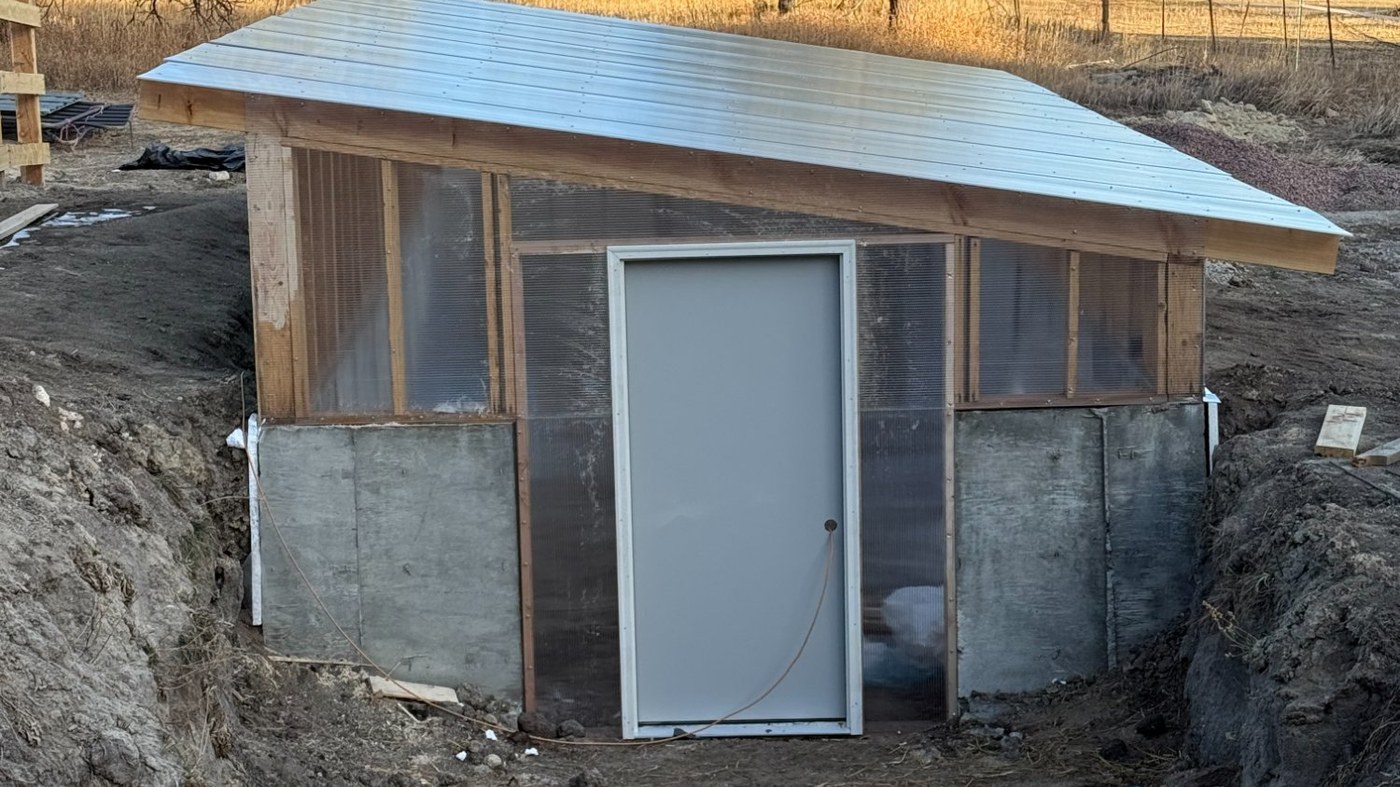
A Walpini greenhouse can work in Colorado Springs, but only if you throw out the viral $300 DIY blueprint and redesign it for our sun angle, snow load, and frost line. I’ve built these in Colorado Springs and the surrounding area, and the version that gets shared online (dig a pit, throw plastic sheeting over it, skip the heating bill) is copied from a design built for Bolivia’s 16-degree-south latitude, where the sun sits much higher in the sky than it ever does here. Built to our specs, a Walpini can hold above 40°F on clear January nights without any added heat. Built to the internet’s specs, it fails within a season or two.
What Is a Walpini Greenhouse, Actually?
The Walpini originated in the 1990s, when volunteers from the Benson Institute at Brigham Young University built a prototype greenhouse for farmers near La Paz, Bolivia. “Walpini” means “place of warmth” in the local Aymara language. The original design: dig a rectangular pit 6 to 8 feet deep, pile the dug-out dirt (this mound is called a berm) against the north wall, lay plastic sheeting over the south-facing opening, and let the earth’s steady underground temperature keep the inside warmer than the outside air.
It worked near La Paz because Bolivia sits at 16 degrees south latitude, where the sun stays high in the sky all year. The original design assumes a sun angle that Colorado Springs simply doesn’t get in winter. That’s the key adaptation most online tutorials skip entirely.
Near La Paz, on their winter solstice (the shortest day of their year), the sun sits about 50 degrees above the horizon at solar noon, the sun’s highest point each day. In Colorado Springs (38.8° north latitude), on our winter solstice, the sun is only 26 to 28 degrees above the horizon at its highest. A shallow roof angle that works in Bolivia will leave your Colorado Walpini in deep shade for most of the winter day. The glazing angle, roof pitch, and interior terrace layout all have to be calculated for our specific sun angle. You can’t just copy a Bolivian blueprint.
Colorado Springs Specifications
| Factor | Value |
|---|---|
| Winter sun angle at solstice | 26–28° |
| El Paso County frost line | 30 inches |
| Design snow load | 30+ psf |
| Stable soil temperature (6–8 ft) | 45–55°F |
| USDA Zone | 5b–6a (varies by elevation) |
| First frost | October 5 (avg) |
Psf means pounds per square foot: how much weight the roof structure has to carry per square foot under a load like snow.
What Actually Works in a Colorado Springs Walpini?
A properly designed Walpini in Colorado Springs can hold temperatures above 40°F on clear January nights without any added heat. That’s warm enough for cold-hardy crops like kale, spinach, carrots, chard, and hardy herbs. Mild frost can still happen inside during long cold snaps or cloudy stretches. Most growers keep a small backup heater on hand for those times.
Glazing angle and orientation
The glazing must face true south, not magnetic south. A compass in Colorado Springs points about 7 degrees east of true south, a gap called magnetic declination, so you need to correct for that when you lay out the greenhouse. The glazing also needs to be pitched at an angle that catches the winter sun as directly as possible. For Colorado Springs, a glazing angle of 50 to 55 degrees from horizontal catches winter sun the best. Flatter angles that look fine in online photos will leave the inside in shadow during the months you need heat most.
Twin-wall or multi-wall polycarbonate (a rigid plastic panel with air channels built in, similar to a double-pane window) is the right glazing material. It insulates much better than single-layer plastic sheeting while still letting in more than 80% of the usable light. UV-stabilized polycarbonate rated for high-altitude exposure is essential. Standard greenhouse plastic turns yellow and brittle within 2 to 3 seasons at this elevation, about 6,000 feet.
Structural framing for snow load
This is where the viral $300 tutorials fail the worst. Colorado Springs regularly gets late-season snowstorms: wet, heavy spring snow that can pile up 18 to 24 inches overnight. Single-layer plastic sheeting over basic wooden purlins (the horizontal beams that support the roof covering between the main framing) can’t handle that kind of load. We’ve seen structures collapse under just 20 to 22 psf of wet snow when they were built to specs pulled from the internet.
The framing standard we build to: cross-braced trusses rated for a minimum 30 psf snow load, a roof slope of at least 2% so snow slides off instead of piling up flat on the glazing, and ridge connections that are bolted rather than nailed. For any Walpini over 200 sq ft, PPRBD plan review will require engineered drawings.
Excavation and drainage
Colorado Springs soil is mostly clay. Clay doesn’t drain well: water pools at the bottom of a hole instead of soaking away into the ground. If a Walpini doesn’t have a proper drainage system at the bottom of the pit, water will collect there. That creates a mold risk and can slowly weaken the footings, the concrete pads that support the walls. On every Walpini we build, we install a layer of gravel with a perforated pipe underneath. That pipe carries water to a drywell (an underground pit that lets water soak away slowly) or a daylight outlet (a pipe that drains the water out downhill, above ground).
Footings must go below the 30-inch frost line set by El Paso County code, the depth frozen ground can reach here in winter. If the foundation isn’t set deep enough, it’s exposed to frost heave: freezing, expanding soil that pushes upward. That can twist the foundation out of shape, called racking, which throws the glazing frame out of square and breaks the seal that keeps heat in.
Ventilation
A Walpini that isn’t designed well will overheat on sunny winter days, even when it’s cold outside. On a clear January day with outside temperatures in the 20s, the inside can climb past 90°F without enough ventilation, meaning fresh air moving through. Vents you can open at the roof ridge and lower down on the glazing wall are a must. Being able to dump heat fast on a warm, sunny day matters just as much as holding heat in on a cold night.
What Can You Actually Grow in a Colorado Springs Walpini?
Cold-hardy crops that grow reliably in a properly designed Colorado Walpini without extra heat: kale, chard, spinach, arugula, mache, carrots (overwintered), radishes, green onions, parsley, and most hardy herbs. Crops that need extra heat for winter production: tomatoes, peppers, cucumbers, and basil. These need nighttime temperatures above 50°F, which a passive (unheated) Walpini can’t reliably hit during Colorado’s coldest months.
The real value of a Walpini is a longer growing season on both ends: you can start crops 6 to 8 weeks earlier in spring and keep harvesting 6 to 8 weeks later into fall. Some cold-hardy crops may even keep producing a little through winter.
What Does a Walpini Actually Cost in Colorado Springs?
A properly engineered Walpini in Colorado Springs typically runs $8,000 to $25,000 or more, depending on size, excavation depth, soil conditions, the type of glazing, and structural requirements. That’s a wide range, but the variables are real. The $300 DIY versions online are not engineered for our snow load, frost line, or high-altitude UV. Structures built to those specifications fail in our climate.
Every Walpini project starts with a site assessment. We look at soil conditions, sun exposure, drainage, and your growing goals before we put numbers on paper. You’ll get a written, flat-rate estimate before any work begins.
Questions people ask
Can a Walpini greenhouse work in Colorado Springs?
Yes, but only with a design adapted to Colorado's latitude and climate, not copied from Bolivian blueprints. A properly designed Walpini in Colorado Springs can maintain temperatures above 40°F on clear January nights without supplemental heating. The critical adaptations: glazing pitched at 50–55 degrees from horizontal to intercept Colorado's 26–28° winter sun angle, UV-stabilized polycarbonate rated for high-altitude exposure, cross-braced trusses rated for 30+ psf snow load, and footings below El Paso County's 30-inch frost line.
What does a Walpini greenhouse cost to build in Colorado Springs?
A properly engineered Walpini in Colorado Springs typically runs $8,000–$25,000+ depending on size, excavation depth and soil conditions, glazing specification, and structural requirements. The viral $300 DIY builds are not engineered for Colorado's 30+ psf snow load, 30-inch frost line, or high-altitude UV. Structures built to those specifications regularly fail within one to two seasons in our climate.
What permits are required for a Walpini greenhouse in Colorado Springs?
A Walpini is a permanent structure with a foundation and requires a PPRBD building permit. Structures over 200 sq ft require engineered drawings. The excavation into Colorado's clay-heavy soils requires proper drainage planning, since our soils don't drain freely and standing water at the base of an excavation is a structural and mold risk. We handle the full permit process on every Walpini project.
Ready to Get Started?
Flat-rate written estimate, no hourly surprises. Serving Colorado Springs, Monument, Fountain, Woodland Park, and the Pikes Peak region.