
Interior painting and cabinet painting for Colorado Springs homes: rooms, ceilings, trim, sprayed cabinets, accent walls, and wallpaper, with prep and paint chosen for dry air and strong sun. Free written estimate, flat-rate pricing.
Interior painting in Colorado Springs with us runs from about $300 for a single bedroom to $5,900–$10,800 for a 2,000 sq ft home with walls, ceilings, and trim, and cabinet painting for an average kitchen runs $2,000–$6,500. It is built for homeowners who want one person to prep, prime, and paint the job properly instead of rolling color over problems. The key qualification is prep: at 6,035 feet, with winter indoor humidity below 25%, a rushed prep job fails early, and in a home built before 1978 I test for lead (and a popcorn ceiling for asbestos) before anything gets sanded or scraped. We work in Colorado Springs and the surrounding areas, including Monument, Black Forest, Fountain, and Woodland Park. Every project starts with a free written estimate and flat-rate pricing, so the number you agree to is the number you pay.
Colorado Springs is hard on paint in two different ways. Outside, UV is about 25% stronger than at sea level and daily temperature swings run 40°F or more, which is why entry doors, porch trim, and south and west faces chalk and fade early. Inside, winter air often sits below 25% humidity, which dries out paint films and the lumber behind the drywall too (that second part is why nail pops and corner cracks show up in newer homes). Our interior painting guide goes deeper on paint selection and sheen.
I handle five kinds of painting and finishing work, from one accent wall to a whole-house interior:
Interior Rooms & Ceilings: Walls, ceilings, closets, and stairwells, with the caulking and priming done before the first finish coat. A clean caulk line along the baseboard is the cheapest thing that makes a paint job look finished.
Trim & Door Enameling: Baseboard, casing, and interior doors in a hard, washable enamel (a paint that dries to a tough, smooth shell), brushed or sprayed depending on the piece.
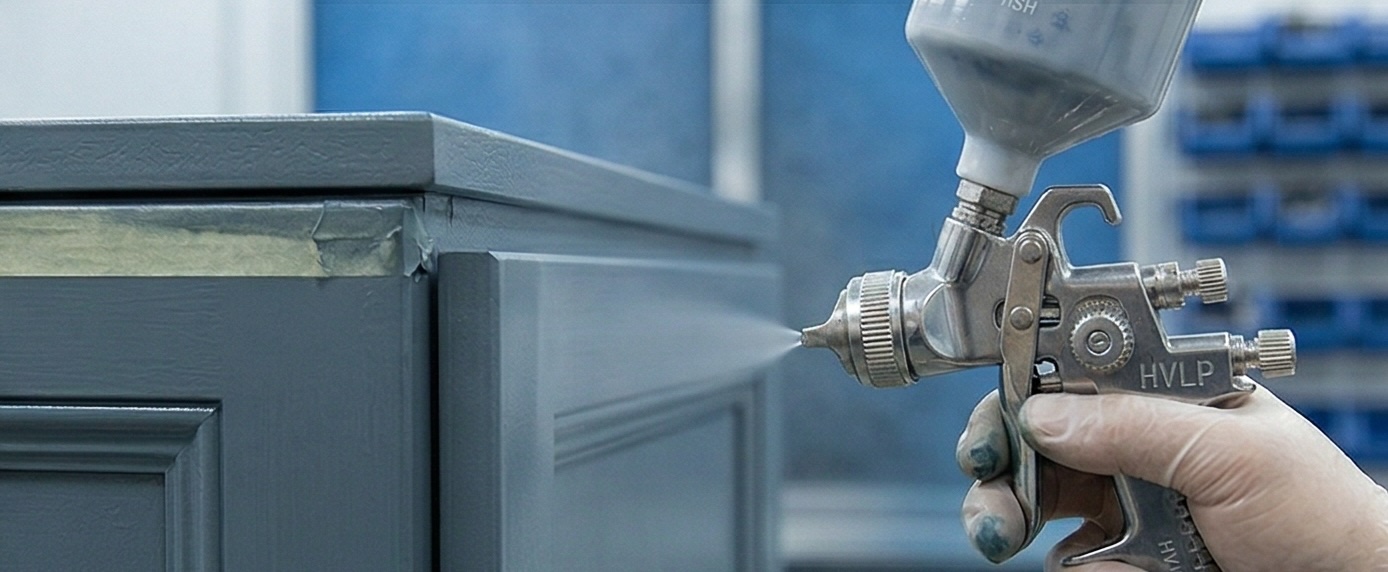
Cabinet Painting: Kitchen and bathroom cabinets cleaned, sanded, primed, and sprayed with HVLP equipment (a high-volume, low-pressure spray gun that lays down a smooth coat with no brush marks). Our cabinet painting guide covers the options, and new pulls and hinges are covered in the cabinet hardware guide.
Accent Walls & Wall Coverings: Painted feature walls, geometric accent walls built from trim and painted, hand-troweled finishes like Roman clay, and wallpaper installation and removal.
Exterior Touch-Up & Trim: Entry doors, porch and garage-door trim, and small areas that need paint. A full exterior repaint of a house is a different job (ladders at height, weather windows, weeks of work), so ask me at the estimate instead of assuming.
Drywall repair, texture matching, and popcorn ceiling removal are not on this list. I don’t take drywall or texture work; if a wall or ceiling needs it, I bring in a drywall sub (or point you to one) and tell you up front, and I paint once the repair is dry and primed.
Interior painting in Colorado Springs typically costs $300–$500 for a single 10x12 bedroom, $500–$1,200 for the same room with ceiling and trim, and $5,900–$10,800 for a 2,000 sq ft home with walls, ceilings, and trim. None of it needs a permit: PPRBD lists interior and exterior painting among the cosmetic work that generally doesn’t, so the price is paint, prep, and labor.
| Scope | Typical Cost | Permit? |
|---|---|---|
| Single room, walls only (10x12 bedroom, 8-ft ceiling, one color, two coats) | $300–$500 | No |
| One room with ceiling and trim (ceiling adds $100–$300, trim $100–$400) | $500–$1,200 | No |
| Whole-home interior, 2,000 sq ft (walls, ceilings, trim) | $5,900–$10,800 | No |
These are market ranges for the Colorado Springs area (some come from national averages), and I turn them into a flat-rate number after walking your house. Ten-foot ceilings or vaulted rooms add about 15–30%. By wall surface, painters here charge roughly $2–$6 per sq ft including prep and materials. Adding doors and closets pushes a 2,000 sq ft home to $7,850–$13,700, and walls only comes in at $3,900–$7,850. Many painters in Colorado Springs carry a $300–$500 project minimum, so ask any painter about theirs before you request a quote for one wall.
Common add-ons, priced at market ranges:
For how I turn a walkthrough into one number, see my handyman pricing guide. Not sure which tier your house falls into? A free written estimate gives you a flat-rate number before any work starts.
Request Free Estimate → (719) 243-9718
Paint your cabinets if the boxes are solid and you like the layout, refinish if you want the wood grain to stay visible, and replace them only when the boxes are failing or the layout has to change. Cabinet painting in Colorado Springs runs about $2,000–$6,500 for an average kitchen, priced at $30–$70 per linear foot, $70–$125 per door, or $120–$190 per cabinet. That range assumes degreasing, sanding, priming, and two sprayed finish coats on the boxes, doors, and drawer fronts, and the door count is what moves your kitchen up or down inside it.
| Option | Market cost | Best when |
|---|---|---|
| Cabinet painting (sprayed) | $30–$70 per linear ft; average kitchen $2,000–$6,500 | Boxes are solid and the layout works |
| Refacing (new doors, keep the boxes) | $150–$450 per linear ft; typical kitchen $5,000–$13,000 | You want a new door style on sound boxes |
| Replacement (new cabinets installed) | $150–$500 per linear ft; typical kitchen $4,500–$15,000 | Boxes are failing or the layout is changing |
Those figures are national averages, and replacement climbs fast once you add countertops, floor repair where the old cabinet bases sat, and wall repair behind the old boxes (a drywall sub’s job, not mine). Per linear foot, paint costs a fraction of new cabinets, which is why I start with paint whenever the layout already works. One Briargate homeowner was quoted $19,000 for new cabinets and paid $4,300 to have the existing ones painted, with repairs and new hardware included (1990s oak kitchens in Briargate are usually the best candidates, because the boxes are solid and only the color is dated).
The test takes thirty seconds: open a door and look inside. Level shelves, tight corners, and no soft or swollen wood mean paint will work. Soft frames, sagging shelves, or particleboard that is swelling from water mean replacement, because paint hides a failing box instead of fixing it. Refinishing a stained finish is priced after I see the wood, since going from dark stain to light means stripping to bare wood. A painted cabinet can’t go back to a stained look, so decide before the first coat. Bathroom vanities get the same treatment, and if the bathroom needs more than paint, that becomes a bathroom remodel conversation.
A handyman painter fits a few rooms, trim, doors, cabinets, or paint that comes with repairs, and a larger painting company fits a whole-house or full exterior repaint that has to be finished fast by a crew. The difference is who handles the problems you find when the first coat of old paint comes off.
On a handyman job, the same person shims the door that sticks, swaps the cabinet pulls, caulks, and paints, under one flat-rate estimate and one schedule. I don’t take drywall or texture work; if your walls need it, I bring in a drywall sub and tell you up front. Many painters in Colorado Springs are painting-only, which is fine for clean walls but means a separate call for every repair. The tradeoff is honest: I’m one person, so a whole 2,000 sq ft home takes 5–7 business days, and a crew of painters can beat that. If your deadline is a closing date, tell me at the estimate and we’ll plan around it. When paint is the last step of a bigger renovation, it folds into our interior remodeling work, so the same crew finishes what it opened up.
Whoever you hire, ask for a written scope that names the prep, the primer, the number of coats, and the paint product (we use Sherwin-Williams Emerald or Benjamin Moore Aura on most interior jobs). We’re licensed and insured, and whoever you hire, ask what their warranty covers before you sign.
A single room takes 1–2 days, a 2,000 sq ft home takes 5–7 business days for rooms, ceilings, and trim, and cabinet painting adds 3–5 days. Most of that time is prep, not painting.
The order on every job is the same: furniture pulled to the middle of the room and covered, floors and fixtures masked, then caulking and sanding, then wiping the dust off every surface before primer goes on (paint over dust is how you get peeling later). Stains and any wall repairs a drywall sub made get primer, then two finish coats. Dust is what clients worry about most. The sanding is mostly glossy trim and cabinets, and everything gets wiped down before primer.
Drying in Colorado Springs works differently than the can suggests. Sherwin-Williams lists Emerald Interior Latex at 1 hour to touch and 4 hours to recoat, but measured at 77°F and 50% relative humidity, and the data sheet says those times depend on temperature, humidity, and film thickness. Winter indoor air here often sits below 25% humidity, so a wall skins over fast and the working time on a wet edge shrinks (fast-drying paint sounds like a feature until you’re the one holding a wet edge across a 14-foot wall). In dry months I paint smaller sections to avoid lap marks (streaks where fresh paint overlaps a section that has already dried), keep the house above the 50°F application minimum on the data sheet, and still follow the recoat time instead of rushing it.
Cabinets feel dry within hours but keep hardening for weeks, so go easy on them early: no heavy scrubbing, and no tape or stickers on the new finish. Each product’s data sheet lists its own cure time, and I go over it with you at the walkthrough.
The most common finds under old paint here are nail pops and corner cracks, glossy oil-based trim that new paint won’t stick to, chalky sun-damaged paint, and, in older homes, lead paint and asbestos-containing popcorn texture. These are patterns by home age, not predictions for your house, which is why the estimate covers prep.
If your walls have finish problems that are about wood rather than paint, our interior wood refinishing guide covers stripping and re-sealing trim, doors, and beams.
Request Free Estimate → (719) 243-9718
Every painting project follows the same five steps, so you always know what comes next:
Ready to price your painting project? Request a free estimate or call (719) 243-9718.
Every project gets a detailed written estimate with flat-rate pricing before work begins. Call (719) 243-9718 or submit the estimate form.